
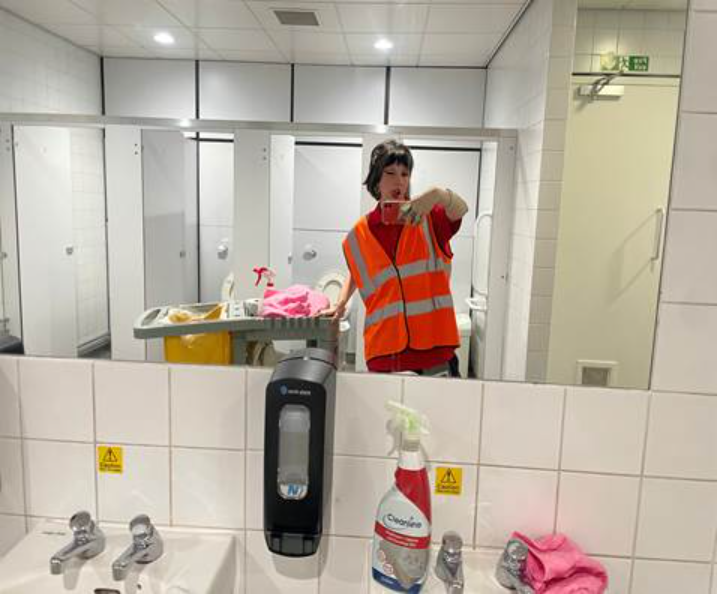
It was 4 am, the beginning of my first twelve-hour shift. I had signed up with an agency, completely blind to what my job role would entail. The agency had advertised the role simply as ‘housekeeper.’ Having been left with no further description, boy, I was in for a shock. I was groggy and a little bit moody from waking so early but was determined to make a good impression.
I looked up.
Above the Hydro was a dragon. A genuinely life-sized dragon, or supposedly life-sized, given that nobody really knows how big this mythical creature should be. I later discovered that it was an eight-meter animatronic dragon, on loan from House of Dragon, 3D scanned and fitted with hidden rotating pumps so it could be suspended above the Clyde. It was genuinely spectacular.
The awe didn’t last long.
As I looked down from the dragon, the cold reality of my role came sharply into focus. I was handed a mop, assigned a partner and told to clean the toilets for the next twelve hours.
That image pretty much summed up my Commonwealth Games: world-class athletes competing, while I scrubbed some world-class messes in the toilets.
As it turns out, toilet cleaning is a lot less glamorous than it sounds. When I wasn’t in the toilets, I was cleaning chairs and floors, which at least meant I could watch some of the athletes training. On my first day I watched the Fiji netball players practising, as I wiped dust from hundreds of stadium chairs. They seemed like giants from where I was standing. The whole thing felt bizarre: elite athletes preparing for international competition while I worked my way along row after row with a cloth.
A few days in, the job became more entertaining. I was cleaning those same chairs while army cadets rehearsed nearby. They stood in formation with perfectly stony faces until we caught each other’s eye. Suddenly, the whole row started giggling. Small moments like this began to break up the twelve-hour shifts.
Meeting people turned out to be the best part of the job.
I was walking roughly 30,000 steps a day, doing endless laps of the SEC (Scottish Events Campus) corridors. Twelve-hour shifts meant we spent an extraordinary amount of time together, and there is something strangely bonding about cleaning toilets alongside someone for half a day. Sometimes it unified us; occasionally it drove us slightly mad. But there were so many kind faces.
There was Moses from Nigeria, recently graduated from Glasgow Caledonian University, and now working punishing agency hours to support his three-year-old son.
There was Josiah, a young man from Ghana with an apparently endless supply of wild stories about travelling through America and around Africa. Their slightly delirious quality began to make more sense when I discovered that he sometimes worked the night shift and the day shift back-to-back. He refused breaks because he was worried that, if he fell asleep, he wouldn’t manage to get back up again.
And there was Fatima, always beaming. One shift ended with her hugging me and delivering an impromptu speech about never letting men put me down while the two of us scrubbed the men’s urinals.
Somewhere in my seventy-second-hour cleaning toilets, I started to enjoy the routine. I began to nod knowingly at the other exhausted workers as I marched through the corridors with my caddy and spray, a little pep returning to my step.
Strangely, I have never received so many compliments as I did while holding a mop and wearing that disgusting uniform. By then, I had begun to feel as though I ruled the toilets.
One of the more surreal encounters happened after work. Going out with my mates after a 7 pm finish, knowing I had a 7 am start, was probably unwise.
Several pubs into Sauchiehall Street, and with slightly less dignity than I had started the evening with, I spotted a group I recognised: The Welsh wheelchair basketball team.
I had watched them earlier that day while cleaning Hall 5, where Australia had comprehensively beaten them. Before the Commonwealth Games, I had no idea how fast or physical wheelchair basketball could be. Players collided, chairs tipped, and athletes hit the floor, only to haul themselves back into their chairs and rejoin the game almost immediately. It was brutal, fast and completely compelling.
Perhaps encouraged by the vodka soda in my hand, I went over and introduced myself. I told them how fascinated I had become by the sport that day and commiserated with them about the result.
One player, in particular, stayed with me. I had watched him being knocked from his chair earlier that day, and the speed and agility with which he got himself back in and continued playing had astonished me.
After that, I began noticing athletes everywhere. Tonga’s netball team would stroll past me in town. Zambia’s boxing team appeared in the KFC near my house. The Games seemed to spill beyond the arenas into ordinary Glasgow life.
Strangely, one of the best things about cleaning the toilets (I know that is a strange thing to say) was that they were one of the few genuinely shared spaces. Athletes, spectators, volunteers and cleaners all passed through the same doors. There was little hierarchy at the sinks.
One day, while I was wiping them down, a Kenya athlete handed me a badge. Others began to recognise me.
‘Still here?’
‘Good on you.’
It was such a small thing, but by that stage of a twelve-hour shift, those moments mattered.
I’m sure the athletes’ spectators and officials would tell a very different story of those Games. Mine involved mops, urinals, 30,000 step days and a uniform I never want to see again.
But perhaps that gave me a strange view of what the Commonwealth Games were really like. I saw the people who competed, the people who watched and the people who cleaned up afterwards sharing the same corridors, cafes, toilets and city.
For those two weeks Glasgow felt different: louder, stranger and somehow connected.
Whenever Scotland won, the roar travelled through the whole building.
Even from inside the toilets, you could hear it.
Leave a Reply