
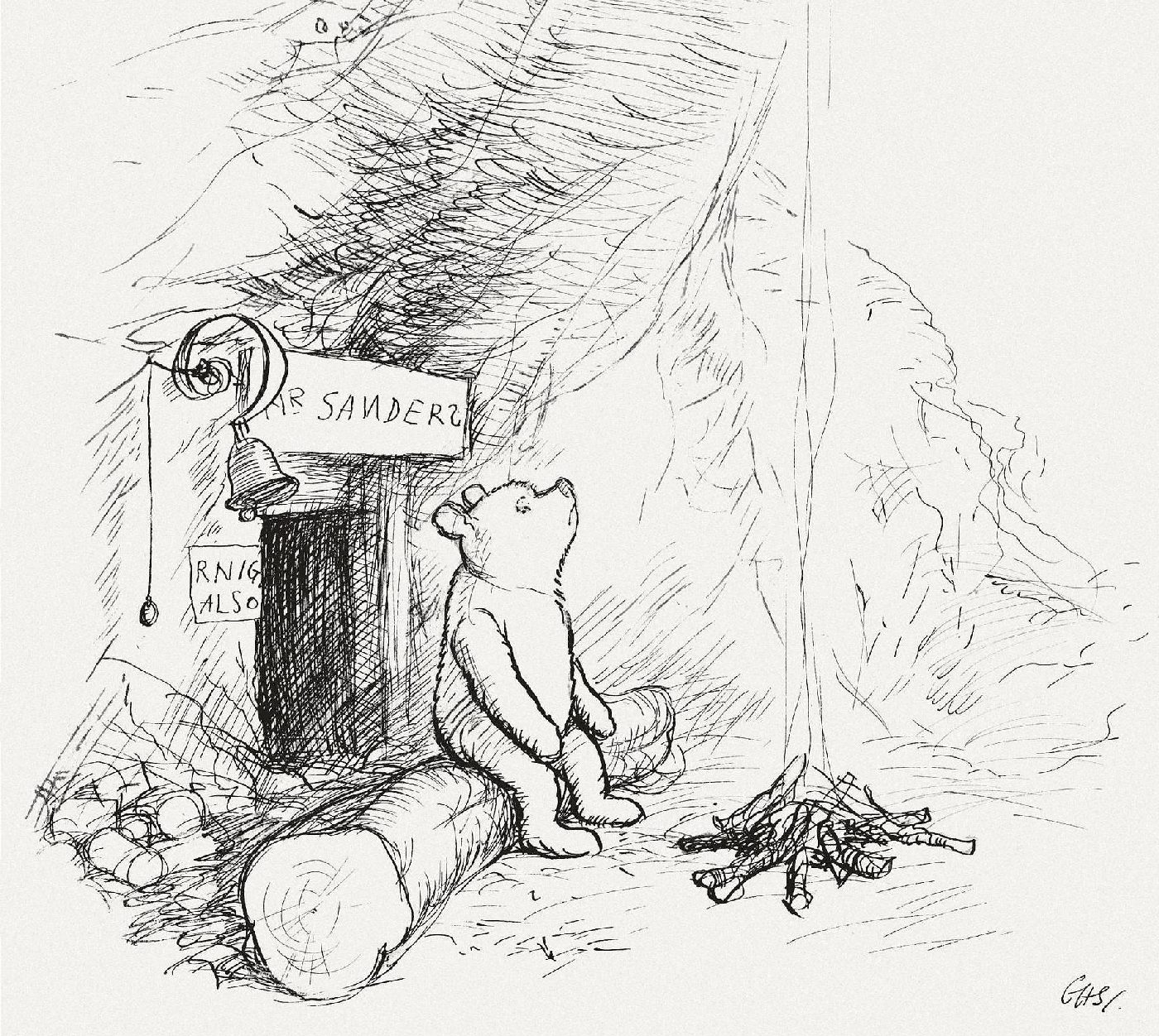
Illustration by Ernest Howard Shepard from Winnie-the-Pooh (1926)
“You can’t stay in your corner of the Forest waiting for others to come to you. You have to go to them sometimes.” – A.A. Milne, Winnie the Pooh.
Sometimes life is hard and horrible, and sometimes it all seems hopeless and lost. But when in your darkest moments and when all else has failed, you can do what my mum would do and turn to the kind yellow bear called Winnie. For all the knowledge and so-called self-help that’s out there (very little of which is any good), sometimes the old ways are best.
The very first ‘Winnie the Pooh’ book was published on the 14th of October, 1926. It was set in the Hundred Acre Wood, a fictional forest where Pooh and his friends live and where the young Christopher Robin explores and adventures with the wise old bear. ‘Old’ being the key word there, as yesterday marked 100 years since the first proper ‘Winnie the Pooh’ book came out.
Pooh first appeared in a story in the ‘Evening Times’ in London on Christmas Eve; the idea for the bear came from Milne’s own son’s yellow teddy bear, which he had bought for him from Harrods in 1921. Milne’s son, who was named Christopher Robin Milne, had a collection of stuffed animals: A bear, a tiger, a donkey, a kangaroo, and a pig.

As Milne watched his son play with his adorable animal collection, he saw through those young eyes the world in which children live. The harmless and the joy. The unabated adventure to be had throughout those endless woods where no danger lurks between the golden roots.
It seems that this simple little yellow bear has a charm to him, as even today, through an entire century, he has persisted in the minds of young and old alike. And it’s easy to see why ‘Winnie the Pooh’ is the creature in all of us that is our true contentment. He is the embodiment of self-confidence.
“People say nothing is impossible, but I do nothing every day.” – A.A. Milne, Winnie the Pooh.
An important lesson to be learned from Pooh is that we must embrace what is truly in our souls. And that’s exactly what Pooh does: when he is hungry, he eats. When he is sleepy, he tells Piglet that he is sleepy and he goes for a nap. He doesn’t worry about the grind; Pooh Bear has never said the phrase: ‘lock in’ or ‘mogged’. He is himself, with no worries.
But more than that, Pooh Bear represents something that seems harder and harder to find as we grow older. He is friendship personified. The ease with which we can make friends as children is something that can define our entire lives; through teenage years and into our twenties, it can seem almost impossible to make friends, then to make time for them, then to keep them through troubles and difficulties.
But Pooh Bear adores his friends; despite their so-called flaws, like Eeyore’s low moods, Tigger’s bounciness, Rabbit’s bossiness, and Piglet’s timidity, he loves them without fail. He sees the joy in companionship, and the love with which creatures can share; the bond between being so different that makes them all alike in love.
Leave a Reply