
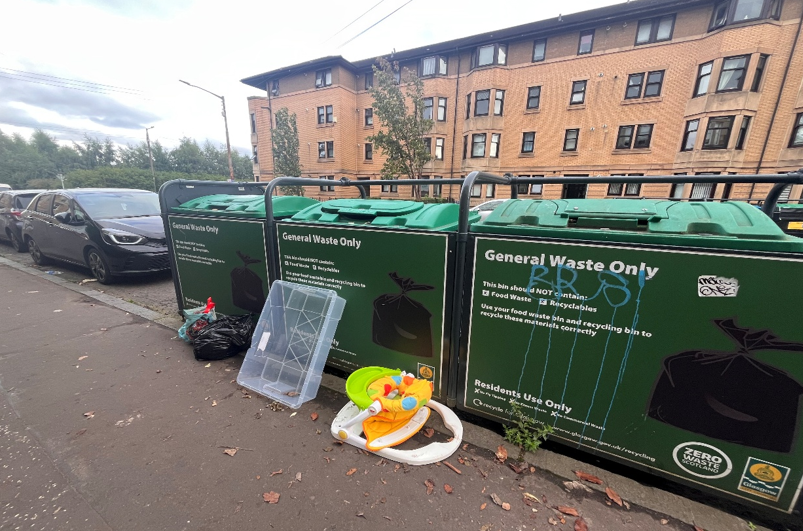
If your postcode starts with G41, then the image above of overflowing bins and rubbish spilling out onto the street may be less of a surprise and more of an everyday sight.
In Scotland’s tenements and housing blocks, managing food waste is an everyday chore. But when bins overflow, bin collections aren’t made or food waste is poorly contained, who bears the consequences — and does where you live determine the environmental risks you face?
The Residents
For residents, the bin is more than a place to throw away rubbish— it is part of the environment immediately outside their homes. When food waste accumulates, bins overflow, or rubbish is left exposed, it can attract pests and create conditions that may pose environmental health concerns.
In a bin hubs trial conducted by the Glasgow City Council in September 2024 for the Pollokshields area, the council found that the residents’ experiences were mixed. The survey covered 1500 flats and 70 hubs.
In the survey:
- 59% disagreed that the areas around the hubs were free from litter,
- 56% disagreed that they were free from fly-tipping; and
- 69% said finding a parking space had become difficult.
Yet there were also signs of improved recycling, with
- 42% said that they were recycling more food waste; and
- 40% said that they were recycling more plastic, tins, cans and cartons.
For residents then, the bins are not just a waste management issue. They are a part of the environment they live in everyday — and when that environment deteriorates, questions about cleanliness, pests, and potential health risks move directly to the doorstep.
The Council and Waste Workers
Official reports published by the City Council acknowledge the structural difficulty of collecting waste from flats.
In a report published by the City Council on 7th May 2025, the council stated its bin-hub approach was intended to address an “overburdened” traditional collection system, including problems with overflowing bins, litter, missed collections and pest control.
The City Council has transformed the bin collection and recycling process to improve local and national recycling performance. The City Council website shows that the process has been completed in several areas of South-West region as part of its Phase-1 implementation.

The image shows number of bins for different waste types that have been installed as part of the new plan, and they serve on average 40 flats on every property.
The collection frequency of bins and waste is different for each bin type.
The website does not mention any dates for implementing the new process in the rest of the city. However, it is speculated that the decision would depend on the success or experience of the South-West region.
The infrastructure provided appears structured and an efficient waste management system, however, in several parts of Glasgow’s south side — including Pollokshields, Govan and Ibrox — concerns about litter, overflowing bins, and the condition of communal waste areas remain prominent.

This raises the question: is the infrastructure at fault or is it user error?
Environmental Health
An overflowing bin isn’t automatically a health hazard. But accumulated organic waste can create health risks, and Public Health Scotland has specifically warned that the health impact of accumulated waste depends on nature of waste and weather conditions.
Food waste is particularly relevant.
Decomposition of food waste creates odour that attracts pests, insects or small animals such as rodents causing further contamination, leading to environmental-health concern.
The Wider, Scottish, Picture
Scotland’s household recycling rate was 43.5% in 2023, well below the national target of 60% that had been set for 2020.
The Scottish Government’s current climate-plan evidence says that recycling disparities are influenced by factors including geography, housing type, deprivation, service design, awareness and investment in infrastructure.
The official website of the Scottish Government lists the following waste and recycling targets as part of their circular economy goals:
- 15% reduction of all waste by 2025, against 2011 levels;
- 33% reduction of food waste by 2025, based on 2013 baseline
- Minimum of 60% recycling of household waste by 2020
- Minimum of 70% recycling of all waste by 2025
- Maximum 5% of all waste to landfill by 2025
- A ban on all biodegradable municipal waste going to landfill by 2025.

Glasgow’s communal bin problem cannot be placed entirely on the council or residents. The council must provide accessible, reliable collections and adequate infrastructure, while residents have a responsibility to dispose of waste correctly and use the facilities provided. When either side fails, the consequences can spill beyond the bins. Environmental health isn’t just about what we throw away — it’s about how it is stored, collected, and managed that shapes the cleanliness, hygiene and environmental conditions of the places we call home.

Hi, I Rashmii Sharma (she/her). I am thrilled to contribute to the Strathclyde Telegraph as a sustainability writer. I am also the founder and President of the Sustainability Society (SITY) at the Strath Union. You can become a member of the society for free and follow us on Instagram @strathsustainability. When I am not digging up policies or interviewing eco-innovators, I love trying hands at complicated recipes and capturing the scenic beauty of Scotland.
Leave a Reply