
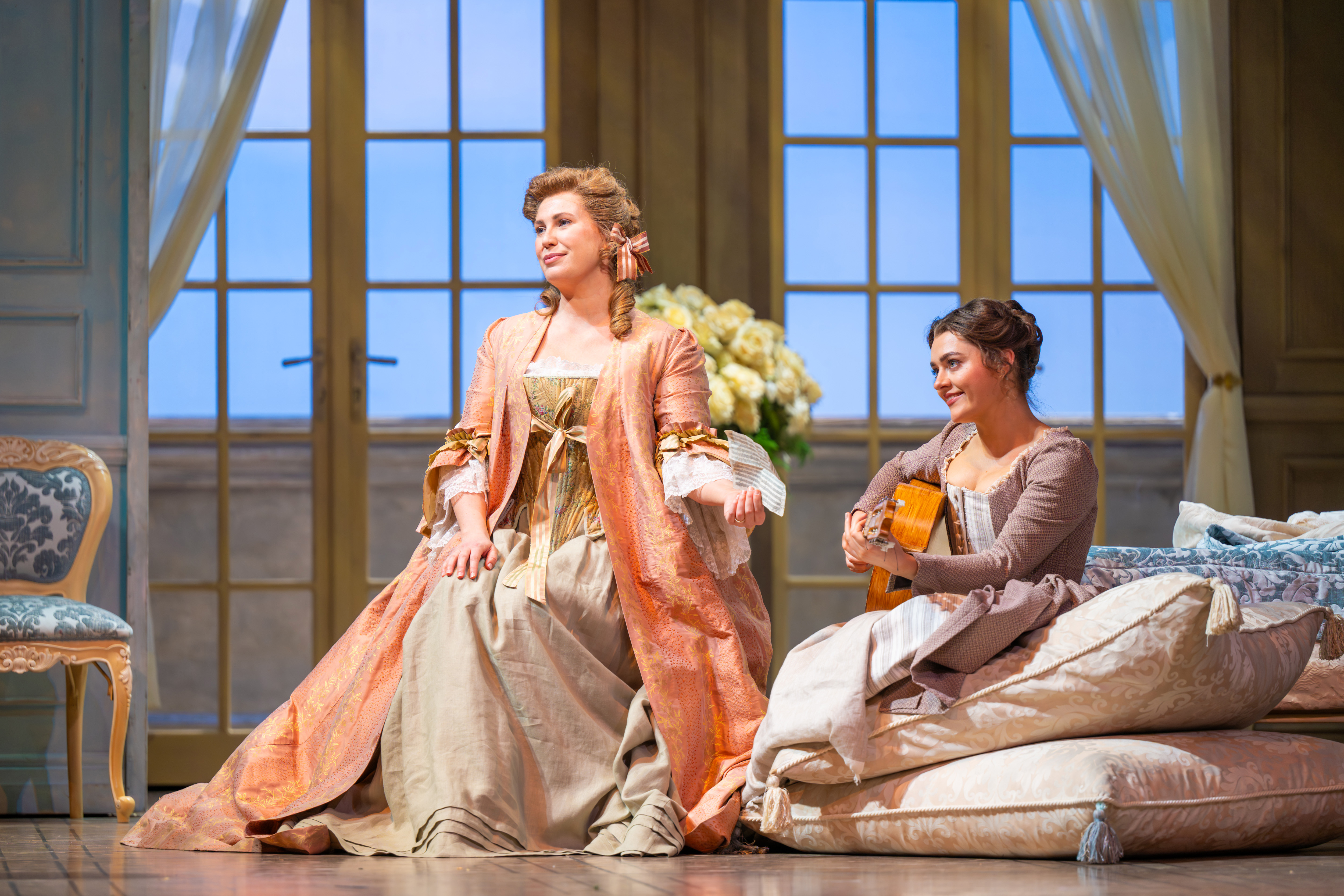
Alexandra Lowe as Countess Almaviva and Ava Dodd as Susann image credit: Scottish Opera
I was invited to attend the Marriage of Figaro at the Glasgow Theatre Royal as the Strathclyde Telegraph arts editor. Having never been to an opera, I had absolutely no idea what to expect from this almost four-hour performance. I went notebook in hand, and exactly no clue what I was about to witness and I’m so glad I did, The Marriage of Figaro was hilarious, it is part 2 of a three part Mozart opera, and although I haven’t watched the first part I found it to be one of the most entertaining, funny and genuinely moving nights I’ve had in a long time.

The opera was a comic masterpiece centred on a single chaotic day in the household of Count Almaviva, who lives with his Countess in Seville. The Count is an unfaithful husband whose eyes roam to his wife’s maid Susanna, the woman engaged to his own servant Figaro. Figaro finds out about his master’s betrayal and his intentions to seduce Susanna on the night of their wedding. All the while, young Cherubino (who was hilarious to watch perform), the Count’s young page, who has just been dismissed for getting caught with Barbarina, their gardener’s daughter, has a crush on the Countess. Figaro makes a desperate attempt to protect Susanna by enlisting the help of Cherubino, Susanna and the Countess. This creates a hilarious plot full of misunderstandings and schemes that keep every member of the household entangled in delightful chaos.
To my surprise, the opera was performed in English with subtitles, which I wasn’t expecting, but I was greatly relieved. Being a newcomer, this felt like a lifeline, especially since the plot is such a whirlwind of chaos, schemes, disguises and misunderstandings, so being able to understand each word allowed me to follow the comedy directly from the first scene, without losing me. In fact, we were led through each plot point, allowing for dramatic irony as we see the Count being deceived by Susanna and Cherubino.

From the moment the orchestra struck up in that magnificent Victorian auditorium, it was clear this wasn’t going to be a stuffy evening. I could see the full orchestra from my seat, and watching the musicians alongside the performers gave the whole night an extra layer of energy. The music was extraordinary, sweeping, playful, and at times achingly beautiful.
The set design was so clever, the sliding compartments built the world while we were watching and transforming the stage to match the unfolding comedic chaos was evident that the production clearly knew how to awe but also have fun.
Each character was realised and three-dimensional, even the antagonists like the Count (Ian Rucker), Bartolo (Edward Hawkins) and Marcellina were engaging and impossible not to enjoy, a good villain drives a plot, and the cast understood this completely.

Each performer carried themselves with the confidence and ease of someone who has spent a lifetime on stage. There was noticeable chemistry between the cast, bringing to life every alliance, rivalry, and stolen glance in a way that felt entirely believable. Susanna, played by Ava Dodd who was beautiful in both voice and presence. The Countess, performed by Alexandra Lowe, delivered a solo that stopped the room, and Ian Rucker’s Count more than matched her with real power and authority in a hilarious solo of his own.

Simone McIntosh, playing Cherubino, was a comedy genius played by a woman portraying a young boy, and an absolute scene-stealer. Sharp, committed, and genuinely hilarious, the performance was one of the highlights of the entire night. Watching a woman pretending to be a man pretending to be a woman added another layer to the impossible comedy and chaos.
There was one small visible slip where the Count required two attempts to slam an object on the table, but in a room already primed for laughter, it only added to the fun. A tiny human moment that the audience adored.
For an opening night, the confidence on that stage was remarkable. There was no tentativeness, no settling-in; the cast arrived fully formed and electric from the very first note, and Edward Jowle, the star of the show or Figaro himself, shed a tear in his final bow that pricked my own eyes, as three hours and twenty-five minutes spent watching them all pour their hearts out was entertaining but profound and powerful.

I arrived as a press newcomer with no real expectations. I left a convert. Scottish Opera’s Marriage of Figaro at the Theatre Royal is funny, moving, occasionally baffling, and never for a single moment dull. For anyone who thinks opera isn’t for them, Glasgow’s Theatre Royal has just made a very compelling counter-argument.
Leave a Reply