
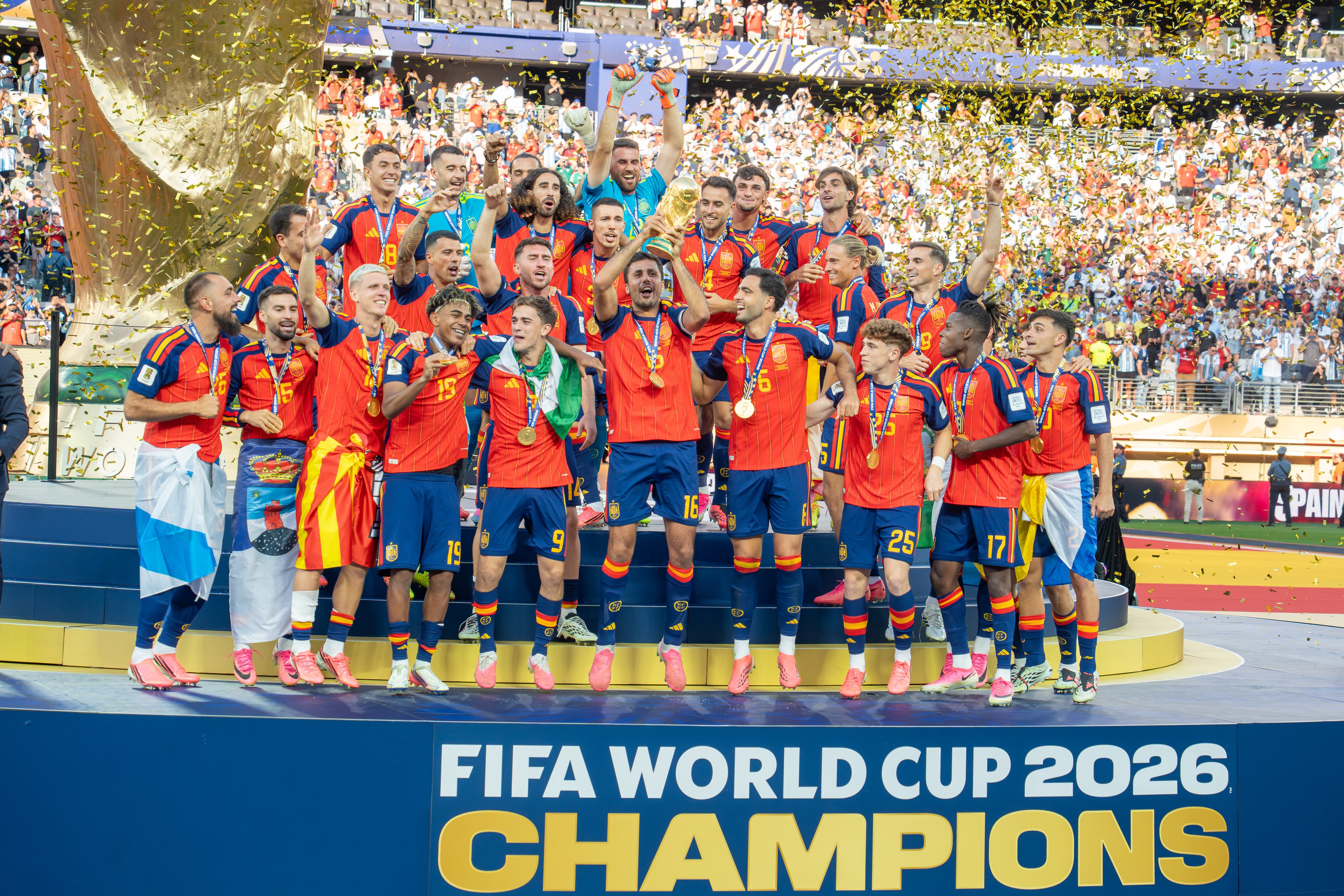
Image Credit : Wikimedia Commons
There was a beautiful symmetry present as Xavi Hernandez, Andres Iniesta, Iker Casillas, Sergio Ramos, Jesus Navas and Carles Puyol all watched on at New Jersey’s Met Life Stadium. They form a group of players who won both the 2008 and 2012 Euro Championships, plus the country’s first ever world cup at South Africa in between. This Spanish team are now just one step away from emulating their big-brother side, with the 2028 Euros awaiting in the UK.
Stylistically, there are striking similarities. They may not be quite as pleasing on the eye (who are) but they exercise a control by possession game and have a balance of youth, experience and know-how. Teenagers Pau Cabarsi and Lamine Yamal have lit up the tournament, while the likes of Pedri, Gavi and Nico Williams will without a doubt have more of a role to play in future tournaments. The conveyor belt keeps on producing.
Experienced professionals like Fabian Ruiz, Dani Olmo, and Marc Cucurella continue to be counted upon, while Rodri showed, after fears that his best days were past him, that he continues to be the best holding midfielder in world football.
And while they have individual talent, there is also a humility to the team. A never-ending desire to work and put in the hard yards. No one eclipses that more than Olmo. From minute one, his off-the-ball work was immense, joining Mikel Oyarzabal in an out-of-possession front two, refusing to allow the Argentinian back four a minute’s peace. It’s no wonder Barcelona forked out over £50 million for his acquisition two summers ago.
Argentina, of course, had their own storyline. Lionel Messi entered what will likely be his last ever match in the famous blue and white. Even at the age of 39, he remains comfortably the best player in the world. In truth, his efforts had single-handedly brought Lionel Scaloni’s side to this stage.
After edging through the play-offs, they were just ninety minutes away from becoming just the third ever team to retain a World Cup title, after Brazil and Italy. Yet, with respect to Cape Verde, Egypt, Switzerland and even England, this Spanish side are an altogether different animal. From minute one, they cut the service to the little magician. The result? They were left looking rather average. Nothing they did resembled potential world Champions.
The Spaniards peppered Emi Martinez’s goal from minute one till 90. 15 shots to 0; it was barely a contest. Luis de la Fuente’s men suffocated their opponents, with a high-defensive line and equally attacking press congesting the game. The tactic of giving to Messi and hoping for the best, which allowed them to dominate proceedings against England, simply wasn’t enough yesterday.

Image Credit: RawPixel.com
By the time extra time arrived, it was only going to get tougher. Already on a booking, Enzo Fernandez flew into a tackle against Cabarsi. In the end, you can debate whether it was a booking or even a foul, yet the 25-year-old gave referee Slavko Vincic a decision to make.
Would Spain be unnerved though? After all, Argentina had defied the odds throughout the tournament. In all of their four previous knockout games, when minute 90 struck, they were level. The mentality monsters had scored nine goals in the final ten minutes of normal time and extra time. An imperfect outfit they may be, but you could never count them out.
Just like their playing style, the Spaniards showed complete composure and trust in their process. They continued to dominate, and would find the ball in the net in the first half of extra time. Nico Williams struck what he thought was the opening goal, only for a foul by Mikel Merino to be ruled on Nicolas Otamendi. Not to worry, they kept plugging away.
Lamine Yamal found the ball on the right-hand side and played a pass inside to Pedro Porro. The fullback played a back-post cross to Williams, who expertly headed into the path of Ferran Torres. The Barcelona striker, whose future is uncertain, struck into the roof of the net to finally split the two sides. It was a just moment. One side had come to play football, another to disrupt. After 106 minutes of one-way traffic, the two sides were finally split.
The 26-year-old thought he had doubled the lead soon after, only to be called back for offside.
Argentina, however, typically refused to give in. At the end of extra time, they came close twice, one with Merino’s terrific interception from Giuliano Simeon’s cross and soon after the Argentine fired over the bar from a corner.

Image Credit: Srpske Novine
But minutes after, the whistle blew and Spain joined the group of seven nations to win two or more World Cups. So the question becomes: how many more can this group win? Everything seems laid out for a dynasty, with a blend of experienced professionals and ever-promising youngsters. Football isn’t played on paper and it rarely works out so simply. However, it will take one mighty effort to stop this group.
Leave a Reply