
by Sarah Borland and Julia Braun Raven
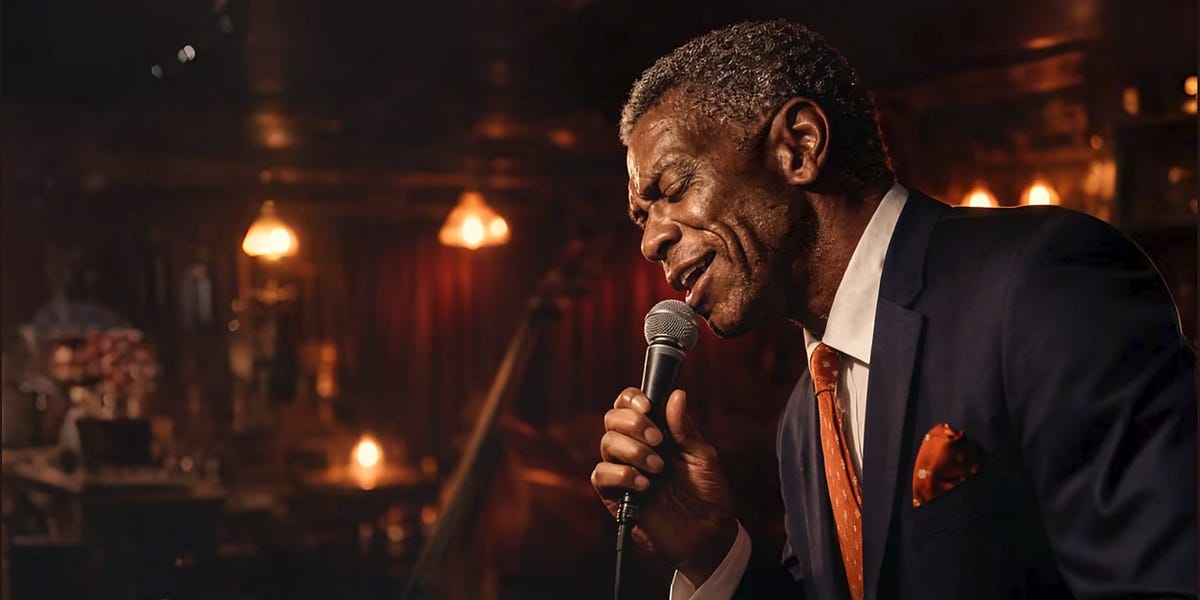
Eddie Dalton’s velvet voice, relatable lyrics and his traditional blues backing band found their way to the hearts of many listeners, leading his debut album to third on the iTunes charts. “I promise that if I say I’m fine, it’s a lie,” he hums.
“I could listen to him all night long, I can’t believe I’ve never even heard of him,” comments fan Lisa Henry on the singer’s Facebook post. But the reason she hadn’t heard his works before isn’t because he’s deeply underrated, but rather because, just like his lyrics, Dalton is also a lie; he is a fabricated product of AI.
Unlike regular musicians who spend their lives grinding away at the craft, Crusty Records, a label that creates virtual artists, brought Dalton to life just last year. And this isn’t the only case; At number 44 on TikTok’s Viral 50 charts sits A Million Colors by Vinih Pray, a Suno generated, doo-wop style track; Walk My Walk by anonymous, digital band Breaking Rust became the first AI song to chart on Billboard’s Digital Country Sales; Producer Timbaland even “signed” an artificial “artist,” TaTa, to his label, Stage Zero.
With AI becoming common practice in the industry, the worry is that AI will eventually become the default songwriter, stripping musicians of all creativity. However, “Technology has always disrupted music,” says Dr Simon Barber, associate professor of songwriting at Birmingham City University.
“When people started using auto-tune, it was like the world [was] going to end because people can’t sing anymore,” he adds. “Even the arrival of the electric guitar, multi-track recordings, and samplers. [These] were huge problems for musicians and now it’s completely commonplace in all kinds of genres.”
Now, someone with no musical background can type a prompt into a machine which will spit out a fully produced track. And this is becoming more common by the day; wholly AI acts are flooding streaming platforms. In fact, Deezer reported that in the past year, roughly 50,000 entirely artificial tracks were released each day, making up 34% of daily uploads.
These tracks then rack up thousands of streams from the creators implementing bots to listen to their songs, meaning these platforms will push them out to real listeners, creating new faces of music like Eddie Dalton.
In 2025, there was a huge increase in artists submitting AI-generated tracks to radio stations, notably BBC Introducing, who intend to give upcoming, unsigned musicians a platform.
Last November, backlash and complaints flooded the station after broadcasting singer Papi Lamour’s music, which is entirely AI, with host Theo Johnson praising its “pitch-perfect” quality.
“We’ve acknowledged…that Al-generated music might be of interest to some of our audience,” says Anthony Browne, BBC Three’s interim head of content, “We’re in the process of articulating what that means [for the stations],.. We’re trying to change our terms and conditions to reflect that.”
To Browne, it all comes down to human connection; no one wants to listen to an AI-generated love song because there’s no real meaning or experience behind it. “If it’s a dance track with a beat and melody, some of the audience wouldn’t mind.”
He feels that technology could never replicate artists like Björk, who are known for innovation and creating new sounds and genres. AI will always create generic, wallpaper music. “It doesn’t have the capability.”
The boundary line of consuming AI music also depends on the listener’s intentions: “Is it something in the background to pass time or an art form where they want to discover new ways of thinking about the world through music,” he says. “Is it just bubble gum for the ears or something that’s going to change your life?”
Barber, however, argues that if AI “becomes too prominent and it is just slop, people will reject it and stop listening… It’ll stop being created in such vast quantities.”
Despite this, there is a difference between only using AI to avoid any artistic input and using it as a tool for manipulation.
Nowadays, instruments like synthesisers and drum machines, commonly used in the 80s for regimented, robotic tones, use AI to create unique sounds from prompts typed by the artist, similarly to lyric generation.
With these, musicians still compose the track’s melodies and rhythm, unlike AI music-generating websites like Suno, where a machine pumps out every instrumental with no human modifications. “But if a human has no hand in making it feel that way, then what is desirable about that?” Barber adds.
Dr Martin Parker, the former head of Edinburgh’s Reid School of Music, feels that if humans have full control over creative choices, they should embrace the technology as it’s “part of the human race now.”
He sees Suno as an equivalent to “scrolling on a phone,” a fun pastime used to give instant music, which most people have no intention of releasing.
“The truth is you do [need] some level of creative skill. You’ve got to have a bit of a background in music production to really engage,” he adds. “I want to call myself a composer. I don’t want a machine to compose for me.”
AI usage, Barber says, depends on “What’s important to us in music,” and “How do we want this thing? What does it mean for what we value? Those are the kinds of questions that we should be asking,” and that it’s not the case of whether “AI is just good or bad.”
“It’s like deciding in a creative project, what is my role in the piece?” Parker explains, “Once you’ve come to terms with what that is, then you need to do the things the role needs you to do. That’s what Machining Sonic Identities is all about.”
Now, Machining Sonic Identities is a project Parker had built with Braid (Bridging Responsible AI Divides), an Edinburgh-based fellowship programme, focusing on AI innovation in the arts and humanities sector to explore AI tools and the ways they are used in the music ecosystem.
Intending to use the tools collaboratively and creatively in his own practice, Parker took inaccessible instruments from music museums and built an archive generated by AI systems. Then, he composed a piece of music for a contemporary ensemble to perform.
Once a sound library was created from the instruments, he built a system to explore it whilst the band were playing on stage in real time. “Using machine learning techniques to uncover new sounds; it was the meeting of live and prerecorded ones. I was very dynamic and alive.”
Parker argues that the world still needs to understand the meaning behind writing, despite AI involvement. “We have to get one step past the prompt. There is a risk we go too far and don’t have an identity ourselves, only the identity that’s been grafted from AI,” he says.
“I’m nervous that if society thinks AI can do all of this work artists do, roles will fall away. Artists have to be respected and acknowledged for the brilliant commentary they give to society and the richness that we wouldn’t have without them.”
Barber takes a similar stance. “I don’t think [musicians] are using it to completely replace themselves; they use it like a tool because it offers options… and takes you down different creative paths.”
Panics over AI are “oftentimes just because it’s new tools people are sceptical of, which ultimately, they’ll find really creative and interesting ways to use,” he adds.
In similar ways, legendary artists have spent decades using unconventional tools for musical creation. David Bowie, one of the most notable singers of the past century, used the “cut-up technique” during his songwriting process, creating unusual contexts for imagery. Although lyrics and metaphors were randomly generated this way, every word still carried human essence. Bowie took lots of different words from magazines, newspapers, diaries – anything he had read – then cut and randomly assembled them together, creating weird, non-cohesive lyrics.
Dr Matthew Lovett, head of Bath School of Music and Performing Arts, feels that all music is an “impossible construct” built up of different techniques that casual listeners won’t pay attention to.
“Popular music is an illusion,” he says.
Lovett recalls the rise of jazz artist Frank Sinatra. When he crooned in the 40s, he sat in the recording studio surrounded by an orchestra. If someone were to sit and listen live, the overwhelming orchestral noise would drown Sinatra out, and he would become inaudible. But mixing technologies allows a balance between both recordings by manipulating volume and sound dynamics.
He views people’s problem with AI as “that sense of being duped,” but that’s what pop music has always been.
“If you’re a British singer, why would you start singing in an American accent?”
Looking at the likes of Adele, “[She] is somehow this authentic artist, but it sounds like American pop music. There’s an amazing British music culture that’s been squashed by American culture. So where do you draw the line with authenticity?” Lovett enquires.
The core thing that horrifies listeners is “this classic example of AI slop stealing the position of a human songwriter. People get annoyed because they are listening to something fake, that they think is great,” Lovett explains, “But actually it just sounds like auto-tuned pop.”
There is a worry that, soon, because of advancing technologies, tell-tale signs for distinguishing human and AI-made music will become too blurred and difficult for the casual listener to make a distinction. In fact, an All-Party Parliamentary Group music report found that 55% of adults in the UK are worried they will listen to an AI artist without realising.
“The first time I heard [Eddie Dalton], I loved it,” says Sandy-the-Gypsy777 on Reddit, “Gobsmacked when I found out he was AI. … Not sure how I feel now.”
“The real music expert could tell the difference,” Browne says. “Despite its best efforts, [AI] always feels a bit rounded [at] the edges, it’s too perfect; it doesn’t have realism to it.”
Barber values human creativity above anything else, as they are the only ones who can create sentient art with a sense-making ability. “When I say that, I don’t mean we know how to put one word in front of another. AI can do that. I mean the ability to put something unusual together that creates new meanings.” With generated lyrics, everything is about probability. Every image is a fusion of millions of preexisting songs absorbed by the AI.
“Humans might say, ‘What could I do here that would make the audience feel goosebumps or strike a dagger through their heart?’ We have that ability to make unpredictable choices, that’s what’s so exciting about art. We can’t lose that.”
Leave a Reply