
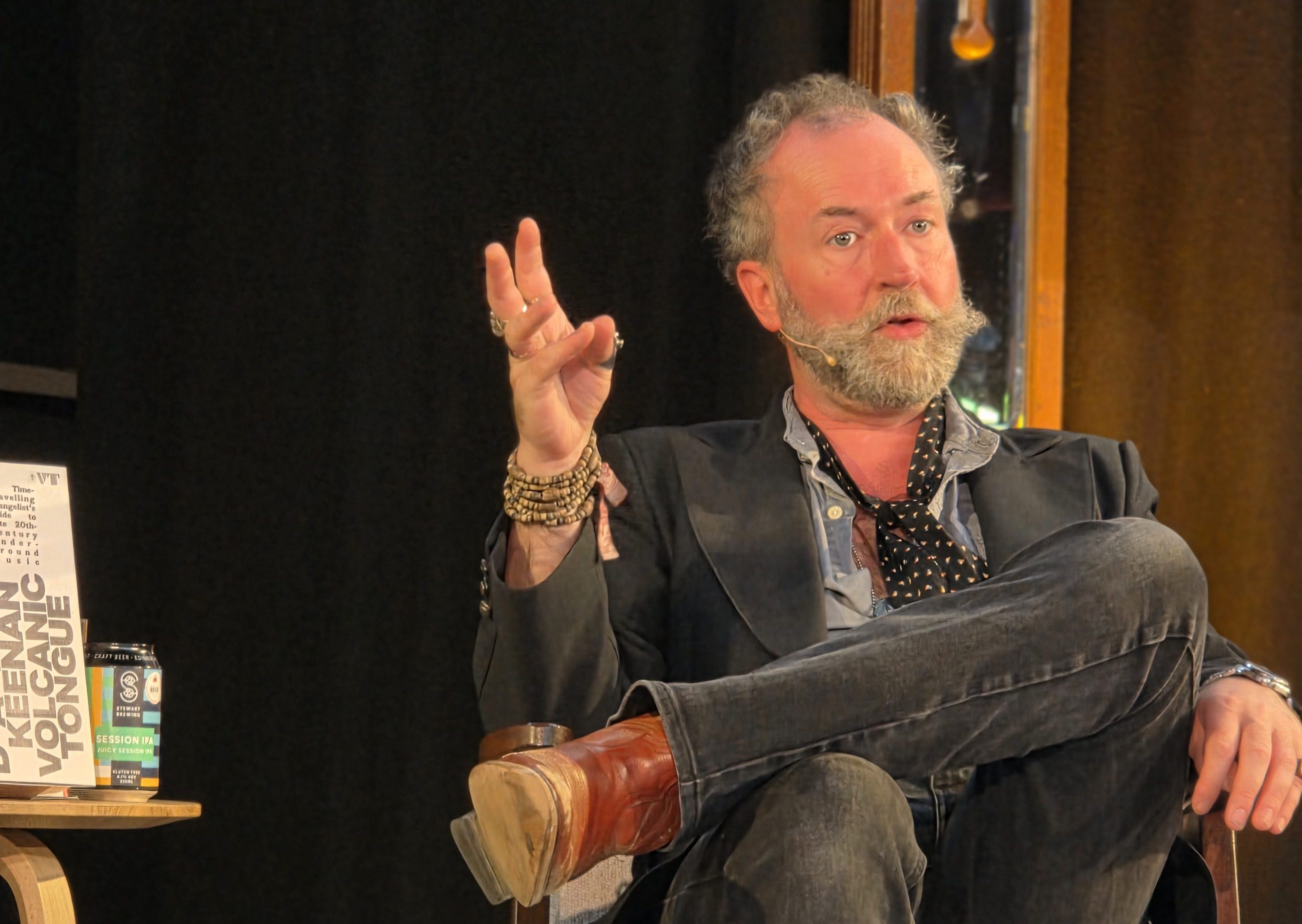
It all started over a year ago with an invitation to a Paisley Book Festival. I arrived unsure of what to expect and unfamiliar with both David Keenan and Stuart Murdoch. Yet from the moment they began speaking about creativity and artistic practice, I could already sense that the evening would stay with me long afterwards.

For me, a first-year Creative Writing student who had only recently rediscovered the magic of writing, the event felt almost like entering a secret society where you are suddenly entrusted with the hidden knowledge of the craft. My senses were heightened, and I am sure the glass of wine beforehand helped too, especially when it came to asking questions.
What intrigued me was Keenan mentioning how, through the interviews he conducted for a music magazine, The Wire, he learned “the rhythm of people.” Curious, I asked during the Q&A about this “rhythm of people” and how it related to the characters in his writing.
He explained that rhythm, for him, is central to character creation: “To get a character across without describing them is to find the rhythm of them. And the rhythm is in how they speak, but also how they move, how they walk down the street, the pauses between their words. I think that’s so expressive, and that’s when they get into the realm of music. So yeah, I would say the absolute core of everything I do as a writer is rhythm.”
It brought me back to discussions in creative writing lectures on the importance of voice in shaping character.
Having a tendency to go a little crazy when it comes to collecting items and often struggling to resist getting the next piece to complete the collection, I ended up going to not one but three events with Keenan. And what a collection of events it turned out to be.
A few months after attending, local to me, Paisley Book Festival, I went to see Keenan again, this time at the Edinburgh International Book Festival. He brought to the event the same energy of a passionate writer and storyteller. During the event, he touched on some entirely different aspects of his craft.

While I had spent much of my university time analysing authors’ intentions, symbolism, and hidden meanings in texts, Keenan introduced a contrasting perspective on writing, in which it is more about the experience of writing and reading than about uncovering hidden meaning.
Speaking about what he called the “isness” of art, Keenan described writing as an attempt to fully access the present moment: “There is only this one eternal moment. And the big quest for me, from art, is to access the moment. To be in the isness.” He later explained that this was why his writing “aspires to music,” because music comes closest to capturing pure experience and presence.
It felt like a revelation. Keenan was not speaking about literature as commentary or explanation, but as something lived and felt in the moment by both writer and reader. It gave me a more complete understanding of writing itself and reminded me that the experience of reading can matter just as much as interpretation. In a way, it brought me back to what reading had once been for me before university — not an act of analysis, but an experience of being fully present in the moment.
Listening to Keenan also made me see writing more clearly as an art form. This idea feels especially close to me as someone who once gave up one form of art in order to pursue another. It made me realise that writers are artists too, and that there is no real boundary between the two — despite how hard I once tried to create one for myself. Thanks to Keenan, I now feel far more comfortable introducing myself not only as a writer, but also as an artist.
Fast-forward to the Paisley Book Festival 2026, when Keenan spoke about his newly released book Boyhood. It is here that I was once again reminded how, for Keenan, writing is art.

Keenan draws heavily from visual artists and painters, and compares his writing process to that of a painter at an easel: “I pull the laptop up. I sit there. And I stare at it the way a painter stares at a painting. Sometimes I will sit for hours. And then I’ll just move forward with a little gesture, add a couple of words, erase a couple of words, move on slightly.”
Like an artist, he constantly challenges his own creative process. “At the moment, I’m working on two parallel novels. One novel, which I’ve challenged myself to write, which is super character-driven. No big revelations. Nothing really happens except people being alive.”
For Keenan, writing is a way of being. As he advises aspiring authors to write every day and speaks about writing as inseparable from himself, he also admits: “I’m always writing, can’t stop. Interestingly enough, I don’t think everything that I write demands publication.”
Across those three events, I learned that there is no one set approach to writing. Each event I left feeling inspired and motivated. Keenan’s words stayed with me for months afterwards as I tried to better understand my own creative process.
If you are an aspiring writer, one thing I can say without doubt is that book festivals and author events can help you understand not only writing itself, but also your own relationship with it. So if you have a free evening, check whether any literary events are happening near you. At the very least, it will be enjoyable, but, as in my case, it might also completely reshape the way you think about writing.

Hi, I am Julia Braun Raven, an award-winning student journalist, having been named Arts Writer of the Year at the Herald Student Press Awards 2026. Following this achievement, I am continuing to develop my journalistic skills and contribute to The Herald’s arts and culture section under the mentorship of Arts Correspondent Brian Ferguson.
I am a third-year Journalism, Media & Communication and English & Creative Writing student. I was re-elected as Editor-in-Chief of the Strathclyde Telegraph for 2026/27. Alongside preparing for the new academic year, I am delighted to continue working with the team to create a student newspaper that reflects student life on campus, while also covering the wider issues shaping the world around us.
Leave a Reply