
Published Anonymously
December of 2024 marked 10 years since same-sex marriage was legalised in Scotland.
Yet as we approach this year’s Pride Month, that sense of progress feels increasingly fragile. Across the Atlantic, a wave of anti-LGBTQ+ legislation is surging. In February alone, lawmakers in nine US states introduced bills designed to undermine the federal protection of same-sex marriage. Under Donald Trump’s shadow, gender-affirming healthcare for trans people has been gutted. Libraries are banning books that dare to speak openly about gender, sexuality, and race.
It is tempting, living in Scotland, to feel distant from the chaos of American politics. But the same reactionary ideologies are at work here too. When the UK Supreme Court ruled that the legal definition of “woman” refers only to someone born female, it wasn’t just a technical decision. It was a blunt instrument aimed at erasing trans lives from legal recognition.
This ruling dismantles protections written into EU law two decades ago. It was a quiet, clinical act of cruelty – and it sets a dangerous precedent.
So what? What does this mean? Where can we look for guidance on what to do now?
One option is looking to the past, to remind ourselves of the significance of pride and the positive change that has been made before in the progression of LGBTQ+ rights.
For me, that means looking at my family’s own gay history.
Great Uncle Andrew
In 2018, my great-uncle Andrew passed away at the age of 74. A few days before the service, one of his romantic partners reached out to my aunt – his niece – with condolences. Until that moment, we had believed Uncle Andrew to be a lifelong bachelor.
We were wrong.
Uncle Andrew had been in relationships with four men. They all knew of one another. It was an open relationship of sorts — a life lived in love, yet lived in quiet.
Seven years later, I still know little about that part of him. To me, Uncle Andrew was the soft-spoken man at the edge of family gatherings, always polite, always peripheral. Perhaps that distance was by design. Perhaps silence was the price of survival.
One probable explanation for why Uncle Andrew never told anyone in the family about a major part of his life is that his brother – my grandpa – was homophobic. Grandpa passed in 2012, when I was eight years old, and so most of what I know about him is from other people’s accounts. And from those accounts he sounds like a loving, if strict person, except, it seems, when it comes to his brother being gay.
Uncle Andrew never came out to him.
It could and has been argued, that Grandpa’s views on homosexuality are a product of the time period he grew up in, yet those ideas are still negatively impacting the time period I am growing up in.
It’s easy to dismiss such prejudice as a product of the time, but those “products” have consequences that echo far beyond their moment. Uncle Andrew was born in 1944. He was 36 when homosexuality was decriminalised in Scotland in 1981. He was 70 when same-sex marriage became legal. For the vast majority of his life, the law told him that loving another man made him a criminal.
And yet he loved anyway.
The first Pride marches took place on June 28 of 1970, in the US to mark the one-year anniversary of Stonewall. Though Scotland didn’t have its first large-scale pride march until 1995, protests against the criminalisation of homosexuality occurred through the opening up of Gay Centers, Gay Clubs and public speaking events.
Though I am unaware if Uncle Andrew ever participated in any form of pride parade or protest, one can imagine that for him they acted as a significant representation of the ongoing fight for rights that he did not have access to.
By contrast, I was 14 when I first confidently identified as bisexual. That was in 2020, six years after same-sex marriage was legalised in Scotland. I have never lived in a country that told me my identity was illegal. I have never had to hide my love out of fear it might break the law.
That difference between what my uncle lived through and what I now live through is the clearest marker of how far we have come. But it is also a reminder of what is still at stake. I am very fortunate and grateful that for all of the time that I have known I am attracted to the same sex, the laws I live under have not told me that my sexual orientation is illegal or lesser.
So What? Why Pride Still Matters
My circumstances have meant that pride parades for me have been more a celebration of the victories achieved in the fight for LGBTQ+ rights and equality, a celebration of our community and the love we have for ourselves. For me Uncle Andrew’s story represents the major progress that has been made in the fight for representation and equality, especially when contrasted with the rights that I have at my age that he didn’t.
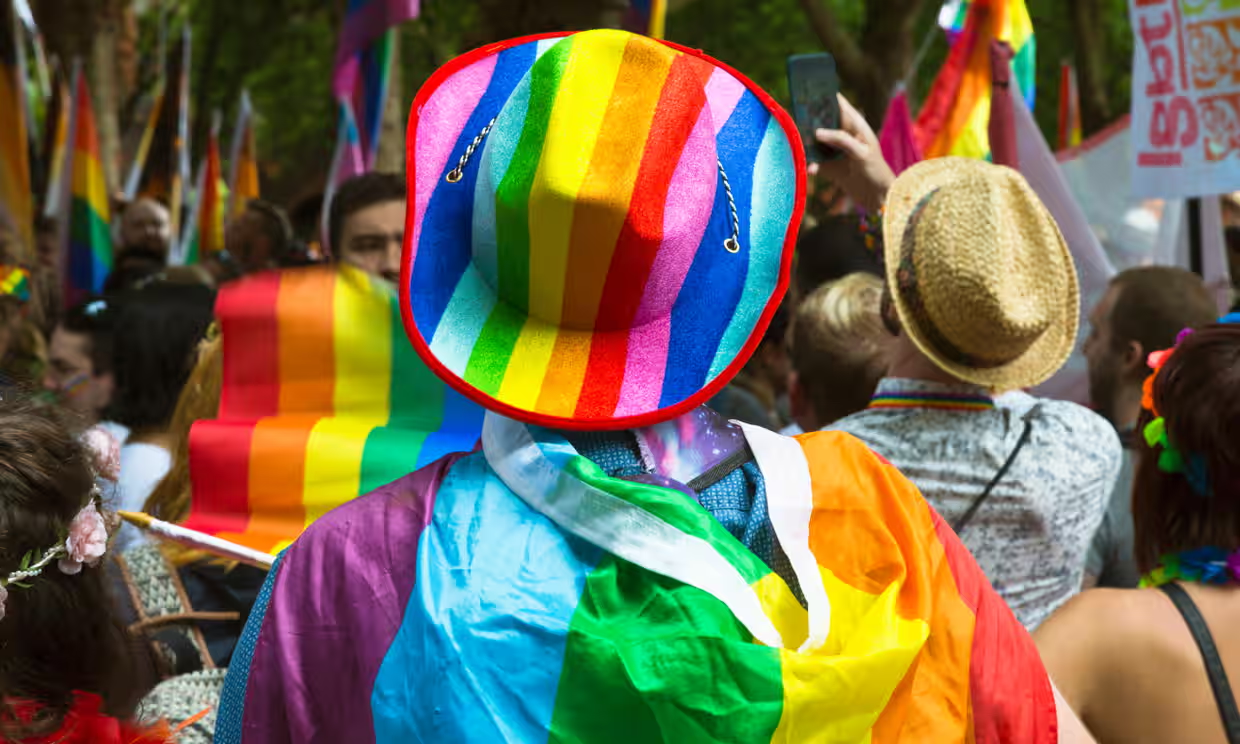
But it also reminds me that pride parades are still a form of resistance against discrimination, a way to strive for a country where queer people can live as themselves without fear of hate crimes.
In the US, Pride parades this year will stand in defiance of anti-LGBTQ+ legislation and rhetoric. In the UK, they’ll protest exclusionary groups like For Women Scotland and rulings that erase trans people’s rights. And globally, Pride will shine a light on the 65 countries where being queer is still a crime.
Progress is not permanent. Rights can be rolled back. And history, if we don’t protect it, can repeat itself.
That’s why we march.
That’s why we remember.
That’s why we keep Pride.
Leave a Reply