
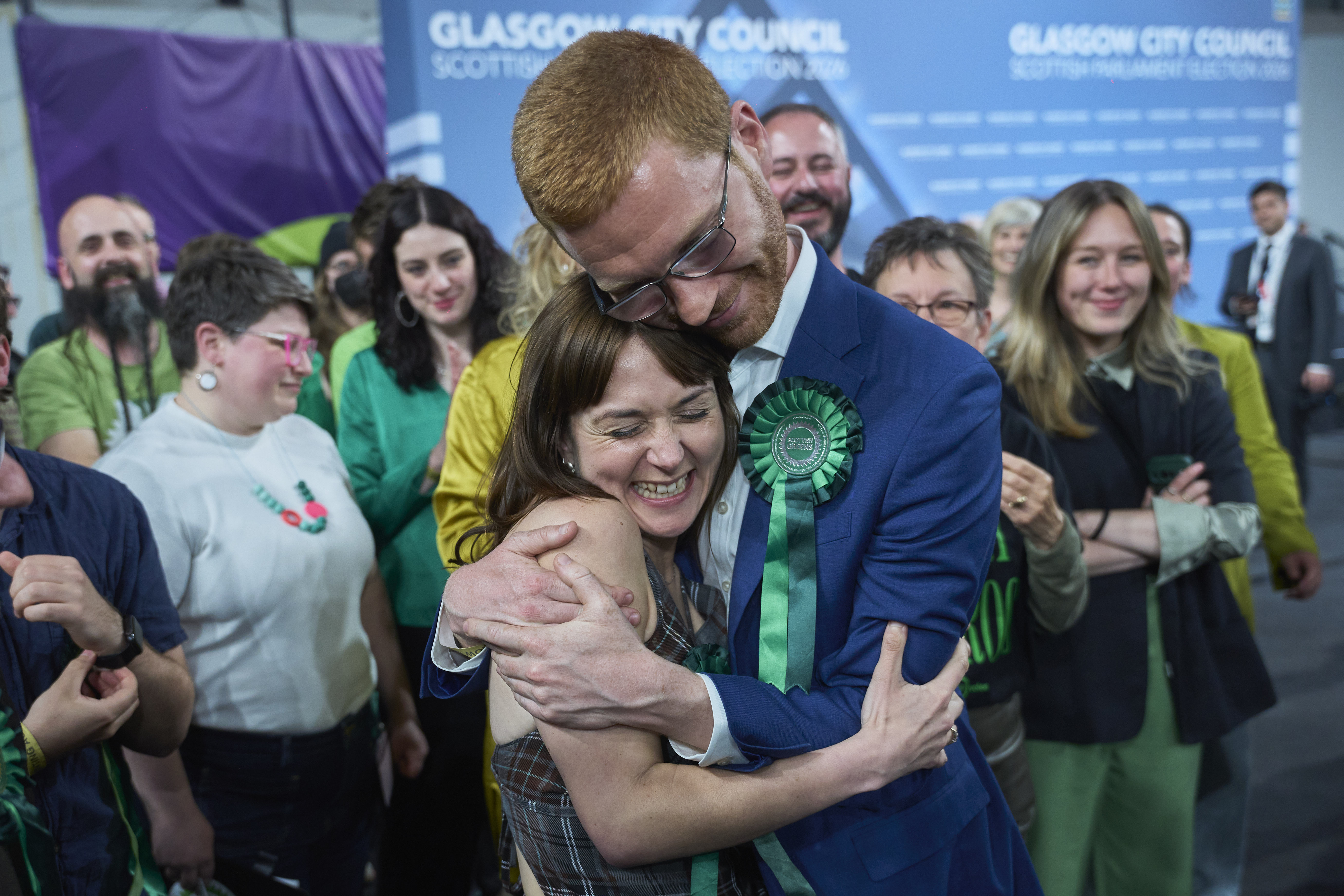
Scottish Greens candidate Holly Bruce (L) hugged by party leader Ross Greer (R)
after winning Glasgow Southside constituency, former FM Nicola Sturgeon’s seat.
Photo: Jason Fong / Strathclyde Telegraph
As expected, the SNP won yesterday’s election with 58 seats; however, they have fallen short of a majority, with Labour and the Reform Party tied for second place, having won 17 seats each. The election has been viewed as a major or minor loss for every party, with the SNP winning, but not by the majority they promised would ensure a mandate for another independence referendum. Possibly the biggest losers were the Labour Party, who faced defeat after defeat in Scotland, England and Wales.
Labour’s campaign was the most politically turbulent, with Anas Sarwar denouncing the party’s leader before it had even officially begun. This was an attempt to separate Sarwar from the negative attitudes towards Keir Starmer and his performance as Prime Minister. This election, along with those in England and Wales, has been shaped into a referendum on Starmer’s leadership, with many commentators believing that these results could see him resign by the end of the week.
At the Glasgow ballot count, the BBC live coverage showed both the Scottish and English results. The presence of Labour was heavy in the room, having woken up with the results from England reporting a major loss in the English Council Elections. Reform performed better than anticipated, gaining a shocking 396 councillors, whilst Labour lost 259. When Anas Sarwar entered the counting room, he was defensive of his decisions and leadership, anticipating the difficult results for Labour to follow in the afternoon. He added that the Labour Party was “hurting”.

Photo: Jason Fong / Strathclyde Telegraph
As the results for Scotland rolled in, Labour suffered repeated shocking defeats. Even Sarwar lost the vote for the new Cathcart and Pollock constituency; a shocking result for a leader who had real aspirations for First Minister only two years ago. After this moment, the atmosphere of the party members became glum, and in some cases, visibly upset. Sarwar’s separation from Starmer questions his leadership and political decision-making. Can he survive if the Prime Minister remains in power?
Now that the results have shown Labour as an unpopular choice, MPs are mounting pressure on Starmer to resign. 33 have publicly denounced his leadership and blame him for the loss of 1500 councillors in England and a decreased vote share in Scotland. Paul Sweeney, Labour MSP, discussed this with me prior to the election.
“Unpleasant as it is to say so, there is no getting away from the fact that Kier Starmer is a political liability […] it is locked into people’s minds that he is not a good Prime Minister and people are not impressed.”
On Friday, Sweeney lost the constituency seat for Glasgow Easterhouse and Springburn to the SNP candidate but was elected on the regional ballot.

Photo: Jason Fong / Strathclyde Telegraph
The subdued atmosphere of Labour was in contrast with the enthusiastic reception of the Scottish Greens Patrick Harvie, Iris Duane and Holly Bruce, when they performed an arguably premature victory lap around the hall to the applause and whoops of supporters. Whilst an early celebration, the Greens were successful later in the afternoon, with Holly Bruce interrupting the SNP’s winning streak by becoming the MSP for Glasgow Southside, beating the SNP’s Kawkab Stewart in Nicola Sturgeon’s former seat. Duane was also successful, missing out on the Kelvin and Maryhill constituency seat but making it onto the regional seat by the end of the night and becoming the first transgender woman to be an MSP. She was alongside the first non-binary Tamil MSP, Q Manivannan, which is significant in an election where homophobic and racist bigotry played a big role in the Reforms campaign.
Despite Reforms’ massive success in England’s council elections, winning 1,453 council seats, there was less of a land sweep in Scotland. The faces of Reform in Scotland, Thomas Kerr and Malcolm Offord, both failed to win the constituency vote. Their campaign was rife with controversy from outrage caused by Offord’s resurfaced homophobic ‘joke’ or his boasting of owning six houses, six boats and five cars at an election debate. Offord admitted to the BBC on Friday that his goal for the election was 20 MSPs; however, the 17 that they achieved still brought them to joint second place with Labour. Undoubtedly, their success can be seen in how close they have gained momentum within a short period of time. The days of the popular consensus being that Reform and Scotland weren’t compatible are over. It is currently assumed that both Reform and Labour will be equally regarded as the opposition in Holyrood and take turns to ask questions to the SNP.

Photo: Jason Fong / Strathclyde Telegraph
There were many close calls, including Banffshire and Coast, which saw the SNP candidate win against Reform by only 350 votes. SNPs’ energy within the Glasgow count went from subdued to enthusiastic throughout the day. After win, after win, Alison Thewliss’s win in Glasgow Central made the members erupt in support. Thewliss had her name cheered whilst she fought back tears during her acceptance speech. I overheard a few of her supporters discussing that they predict she will be in John Swinney’s cabinet.

Photo: Jason Fong / Strathclyde Telegraph
The question of independence was a major factor in the SNP’s campaign, with Swinney promising an independence election if a majority was achieved. He believed it would be a sufficient mandate despite Westminster rejecting this claim. Now that Swinney is short of a majority, there are questions regarding whether they are still able to achieve independence, possibly by creating a pro-independence majority with the Scottish Greens. A formal or informal coalition could be essential for the SNP’s political aspirations.
As the news of the results is settling, Starmer’s leadership is being strongly opposed. Labour MP Catherine West has threatened to trigger a leadership contest if cabinet ministers fail to challenge Starmer. The future for the Prime Minister is uncertain. Will he last a couple of days, the week, or remain defiant and survive this period of turbulence? The elections across the UK showed a shift in the political sphere; they were widely unpredictable with a record number of undecided voters and a 53.1% turn out in Scotland. Scottish politicians have profoundly failed to identify and address issues facing the Scottish voters and this is evident in a lack of campaign enthusiasm and a dislike for politics in general. What is to follow could be a mix of leadership contests, coalition negotiations and a wide shift in political strategy.

Photo: Jason Fong / Strathclyde Telegraph

She/Her
Leave a Reply