
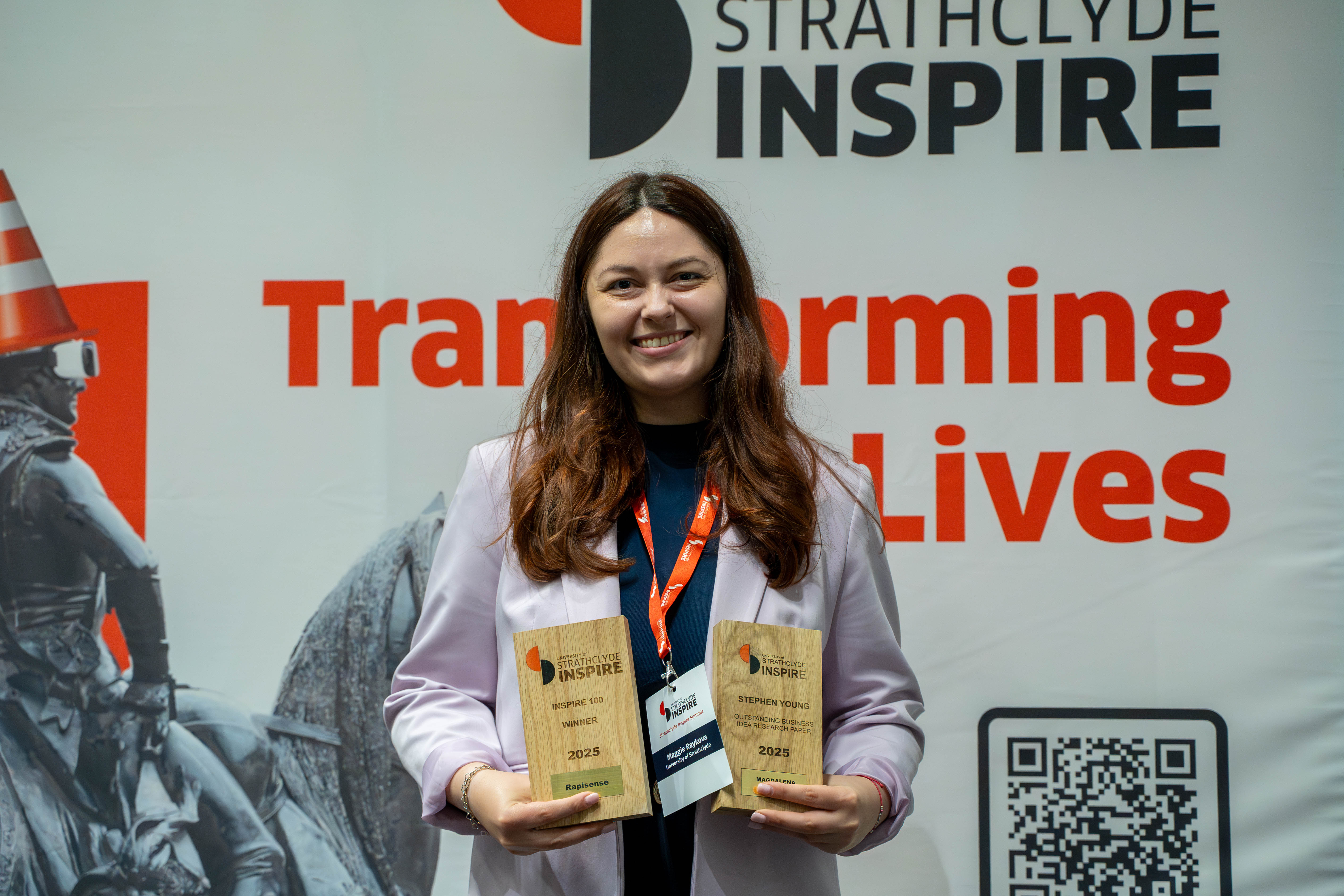
As you enter higher education with a romantic dream of what your future career may look like, it’s likely that, as the years pass, you’ll be surprised at how things turn out.
Originaly from Bulgaria, Magdalena Raykova moved to Scotland thinking she would one day help solve crimes, and went on to graduate with a BSc(Hons) in Forensic Investigation from Glasgow Caledonian University. Though she could never have predicted her dreams of becoming a forensic investigator evolving into an environmental science career.
During her studies, she discovered a love for working in the laboratory, which led to her dissertation on detecting antibiotics in wastewater effluent. On the ever-present dilemma of tap or bottled water, she laughs and says, “In Scotland, always tap; everywhere else, bottled.” It makes you wonder what she’d say about drinking Irn-Bru.
Joking aside, her concern for what we consume and what ends up in the environment is exactly what drives Raykova’s work detecting antibiotic residues in milk and beyond.
Before starting her PhD in Civil and Environmental Engineering at the University of Strathclyde, Raykova worked at Charles River Laboratories, where she conducted analyses on pesticide degradation in soil and water. Looking for a new challenge, she gave up the security of her job to return to university and focus on her postgraduate studies, which she completed in 2024.
Now, Raykova is an Entrepreneurial Lead and Research Fellow, leading an exciting pre-spinout called Rapisense, which develops advanced sensors that automatically detect tiny contaminants in milk and other samples. Their technology aims to help the dairy industry to reduce waste, protect the environment, and support safer, more sustainable food production.
It was this vision that Raykova pitched during the Strathclyde Inspire Summit on May 30, 2025, as part of the Inspire100 pitch competition. This initiative enables start-ups and spinouts to present their business ideas to entrepreneurs, investors, and experts, seeking funding and support.
Winners on the day included Adam Foulis, founder of Scotia Biotech Ltd, who won the £1,000 People’s Choice Award for his rapid, saliva-based concussion test for athletes and Adarsh Bhardwaj, founder of Regeno, who received £7,500 from Santander Universities for developing a flat-pack, plug-and-play wind turbine.
In recognition of her work, Raykova received a £10,000 Stephen Young Entrepreneurship Award and was also honoured with an Outstanding Research Paper award, based on her PhD work, that forms the foundation of what they are building at Rapisense.

One of the biggest global health risks today is antimicrobial resistance (AMR), where bacteria become resistant to antibiotics and medicines, making infections harder, or even impossible, to treat. Raykova’s work on faster detection of antibiotic residues, which can help catch contamination early and reduce the spread of resistant bacteria, is of great significance.
She may not be a forensic investigator like those in CSI, but with further development, her work has the potential to make waste disposal safer and possibly even help prevent future pandemics.
Raykova recognises the importance of support and encouragement she receives, however, not only from her family and friends but also from her mentors at the university, Dr Andrew Ward, Prof Damion Corrigan, and Prof Fiona Henriquez-Mui, who continue to guide her.
Organisations and national initiatives, including Royal Academy of Engineering Enterprise Hub, Converge and Strathclyde Inspire, have not only helped her develop business skills but also supported her in building connections and securing funding. She is determined to make the most of every opportunity.
Another surprise for Raykova was stepping away from the lab and into an entrepreneurial role, going out, making connections, and pitching her ideas to attract investment. Growing up, she watched her parents run their own business, which she assumed she’d never do, yet here she is learning how to commercialise her idea, gaining new skills and an entrepreneurial mindset.
While it may be a path she never imagined for herself as an introvert, she hopes her story might encourage other students to do the same, helping them to step out of their comfort zones by accepting opportunities and challenges that come tieir way.
Her advice to students is simple: if you have an idea, don’t be afraid to explore it. “Talk to as many people as you can, build that network, even if it doesn’t work out, you never know where it will lead you next,” she says. After all, as Magdalena’s journey shows, you might surprise yourself.

Hi, I am Julia Braun Raven, an award-winning student journalist, having been named Arts Writer of the Year at the Herald Student Press Awards 2026. Following this achievement, I am continuing to develop my journalistic skills and contribute to The Herald’s arts and culture section under the mentorship of Arts Correspondent Brian Ferguson.
I am a third-year Journalism, Media & Communication and English & Creative Writing student. I was re-elected as Editor-in-Chief of the Strathclyde Telegraph for 2026/27. Alongside preparing for the new academic year, I am delighted to continue working with the team to create a student newspaper that reflects student life on campus, while also covering the wider issues shaping the world around us.
Leave a Reply