
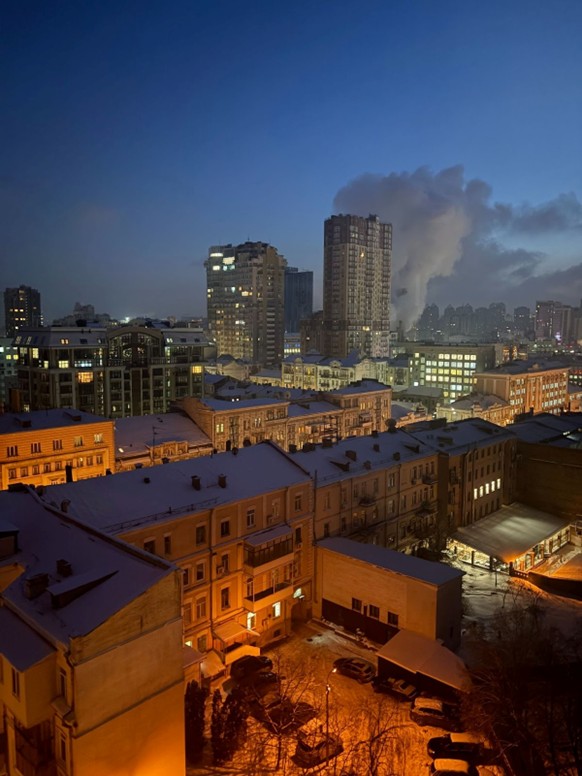
Kyiv in January 2026 – Image Credit – Denis Maher Kavanagh
Mid-January 2026 I travelled to Kyiv, the capital of Ukraine. Due to the ongoing war with Russia, what would normally be a four-hour flight became a convoluted and fragmented journey involving two planes and a 21-hour bus ride. I travelled as the only Irish person on a bus full of Ukrainians returning home, many unable to speak English, navigating a journey that has become routine for them since the invasion began.
Kyiv is a city repeatedly forced into darkness, not because of technical failure, but because electricity is being deliberately taken away from it. Over four days and three nights, I experienced blackouts that are now part of daily life for millions of people living in the capital. When the power went out, there was no panic. Businesses switched on generators, and the constant hum of diesel engines filled the streets as people continued their day-to-day routines almost immediately.
These blackouts are the direct result of Russia’s continued attacks on Ukraine’s civilian energy infrastructure. They are not incidental, nor are they unexpected to all that live in the city. Their purpose is to place pressure on ordinary people, particularly during the harsh winters, by stripping homes, businesses and public spaces of power and heat. In Kyiv, it was clear that residents had no option but to adapt.
“Preparation has replaced surprise.“
Denis Maher Kavanagh
During the peak of winter, temperatures could drop to as low as -25 degrees Celsius, leaving hundreds of thousands of homes without reliable heating or electricity. In these conditions, power is not a luxury but a necessity. Yet blackouts have become something to plan around rather than fear. Charging devices in advance, adjusting schedules, and relying on generators are now second nature to the Ukrainian people.
Despite the disruption, the blackouts have not broken the resolve of the Ukrainian people. Whilst there I took the opportunity to train at a local mixed martial arts gym. Without warning, the power cut out mid-session. After a brief pause, phone flashlights were switched on and training continued. The interruption was treated as normal, despite the fact that ironically normal was something that no one had experienced for a long time.
As I write this article Russia continues to hit the electrical substations around Kyiv, reinforcing the reality that blackouts, that I myself experienced, are not temporary or isolated. These attacks are a constant to the people of Kyiv. In the absence of any major success in warfare, the Russian military uses weather conditions to wage war on civilians to further the impact of the war and to cause damage wherever possible.
While the lights in Kyiv may flicker and fail, the city itself continues to thrive in the intermittent darkness. What I witnessed was a population meeting deliberate hardship with resilience, solidarity, and a determination to endure.
Leave a Reply