
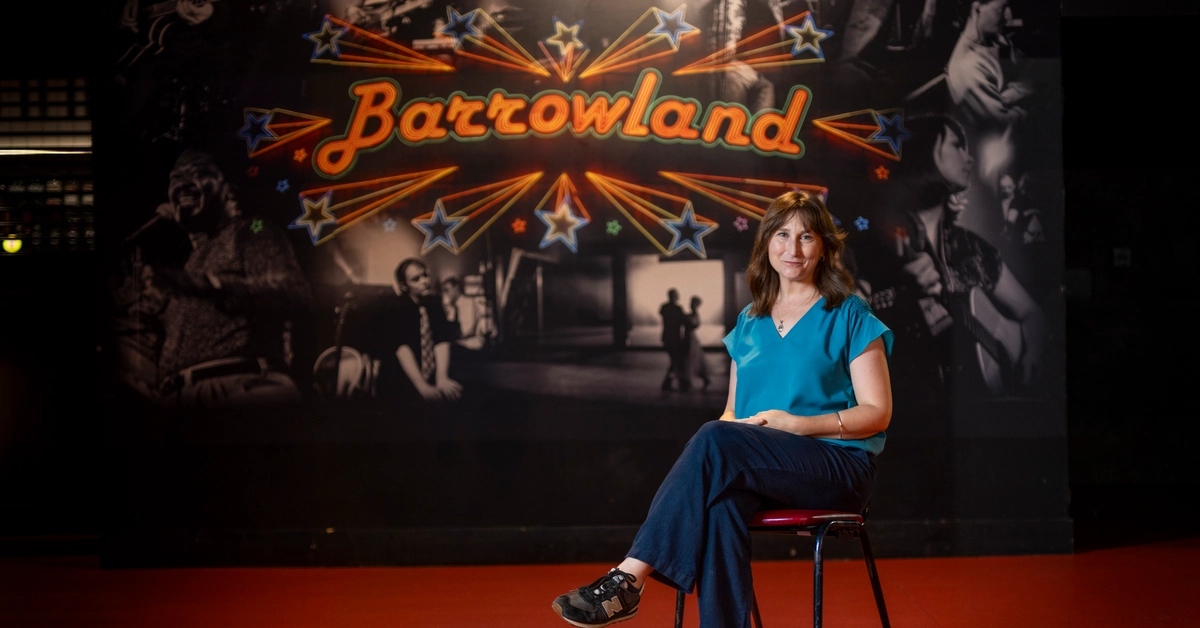
I was greeted at the door by a bouncy and fluffy black dog called Luna as the rain and sun intermittently swapped places outside. Alison Irvine came to the door once Luna had had a good sniff of me and deemed me acceptable to enter her owners lovely flat in the southside of Glasgow.
Alison Irvine is a London-born author who moved to Glasgow in 2005 to study creative writing. Her work which includes fiction and creative non-fiction, has been published in The Herald, The Big Issue and she has been the recipient of awards and funding from Scottish councils to support her work.
I first encountered her work in 2022 as I was looking for material to inspire a project for a college course, I needed sources for a piece about the high-rise estate that once stood near the Barmulloch area of north-east Glasgow, in a place called Red Road.
As fate would have it, I found Irvine’s book online called: ‘This Road is Red’, a creative non-fiction novel that she had been commissioned to write by Glasgow life in 2010 as the estate was facing demolition. She interviewed and chatted with ex-residents and their neighbours to build a narrative of the towers as they once were in 1964 when they were put up and their new tenants moved in, all the way to the very end, run-down and doomed.
I sat down with Alison in her warm and comfortable flat in Glasgow and as her curious black dog, cuddled up to us both, she took me through her process, her idea on editing and reviewing, and her thoughts on what being a student must be like today.
The Red Road flats were torn down between 2012 and 2015, and 15 years have passed since Irvine’s debut novel was published. Since then, the area where the towers once stood has remained the same, the boundary of the scheme still stands as a tall green fence and each pile of grey rubble still sits like gravestones for each block of flats. Unchanged, unlike Irvine’s ideas of the novel itself: “’This Road is Red’ was my first book and I was used to writing fiction so I thought I’ll fictionalise the stories… it was real people’s stories and lives, with their permission it would have been best non-fiction.”
Whatever kind of writer you are, there is freedom in writing. Fluidity and variety are both within your control, “I often start out to write and I think I don’t know what I’m going to write today, and then I’ll get an idea as I’m writing.”
Fiction and non-fiction writers would both agree that in some capacity, the writer is present. We all have a voice that will always echo throughout anything we convey, but with non-fiction, Irvine finds that having real people, real voices, she can craft their stories more vividly as though they were acting it all out before her.
“I can hear their voices in my head because I’ve recorded the interviews and then they’re my characters. The hardest bit is often the stories are quite small and fractured.”
This is where the writers voice comes through. Gathering the voices of real people, and even with non-fiction, building those segments together to form a narrative that eventually becomes a story. Except the story has reality at its very core.
One of the most exciting parts of being a writer, you may disagree, is the sense of pride that comes from seeing ‘The End’ at the bottom of the page, but here the work is only half done. Whatever you happened to have written will be a product of the circumstances in which it was written and re-reading it may produce a different arc or narrative. Or even a single sentence may change, if you see how it could be improved. Alison Irvine has experience with this too: “Don’t send it away until its completely ready, I’ve got a literary agent and she would read anything at any stage but my pride would not let her.”
“With fiction you need to leave it for three months… you need to wait because it will never be finished.”
If however you are not a writer, it’s probably safe to say you are a student. Many young people, me included, battle with feelings of pressure or feeling like we were not ready for university at whatever stage of life we happen to be in. Alison herself felt this when she went to the university of Lancaster right after school, feeling plunged into a vast world of independence.
“It is different for students now,” We both laughed. Having gone to university first at 18, Irvine felt it wasn’t quite right for her at the time. Then at 30 she returned to education and found it massively more enjoyable.
“It’s harder for it [university] to be a priority, because of the financial constraints,” one of the biggest challenges that Irvine recalled from her first time at university was the concept of independent study and the vastness of the responsibility placed upon students to motivate themselves. She explained poignantly that it must be harder for students these days to balance work with studies, especially as money is harder and harder to come by now.
Academic pressure may be a new sensation for newcomers at university, but in this ever-increasing world of performance and demands, there is more and more pressure to succeed and sacrifice for an end goal. “I was privileged to go [to university] and for it be seen… as three years of fun, and I think maybe the scales have tipped a bit more towards study and outcome and results,”
With any luck, if you’re reading this you are a fresher and this next piece of Irvine’s advice which I will now pass on is one that I think we would both like you to remember.
“I would still try and say, have the fun… join the clubs, do the things that you have always wanted to try, make the friends.”
Theres a pretty good chance that whoever you are reading this, you were around when the world shut down in 2020, and there’s a good chance that you were quite young. Like many of us you may feel that the world has become insurmountably digitalised and in many ways disconnected from what matters the most, “You have to put yourself out there but it’s harder, its scarier.”
University can be stressful, of course, and it will be. But the other side of that is that it can also be the remedy for the anxiety it causes you. With over 200 clubs and societies at Strathclyde, you are bound to find your people and your passion, “I’d encourage people to try and find that outlet for their… wellbeing.”
Leave a Reply