
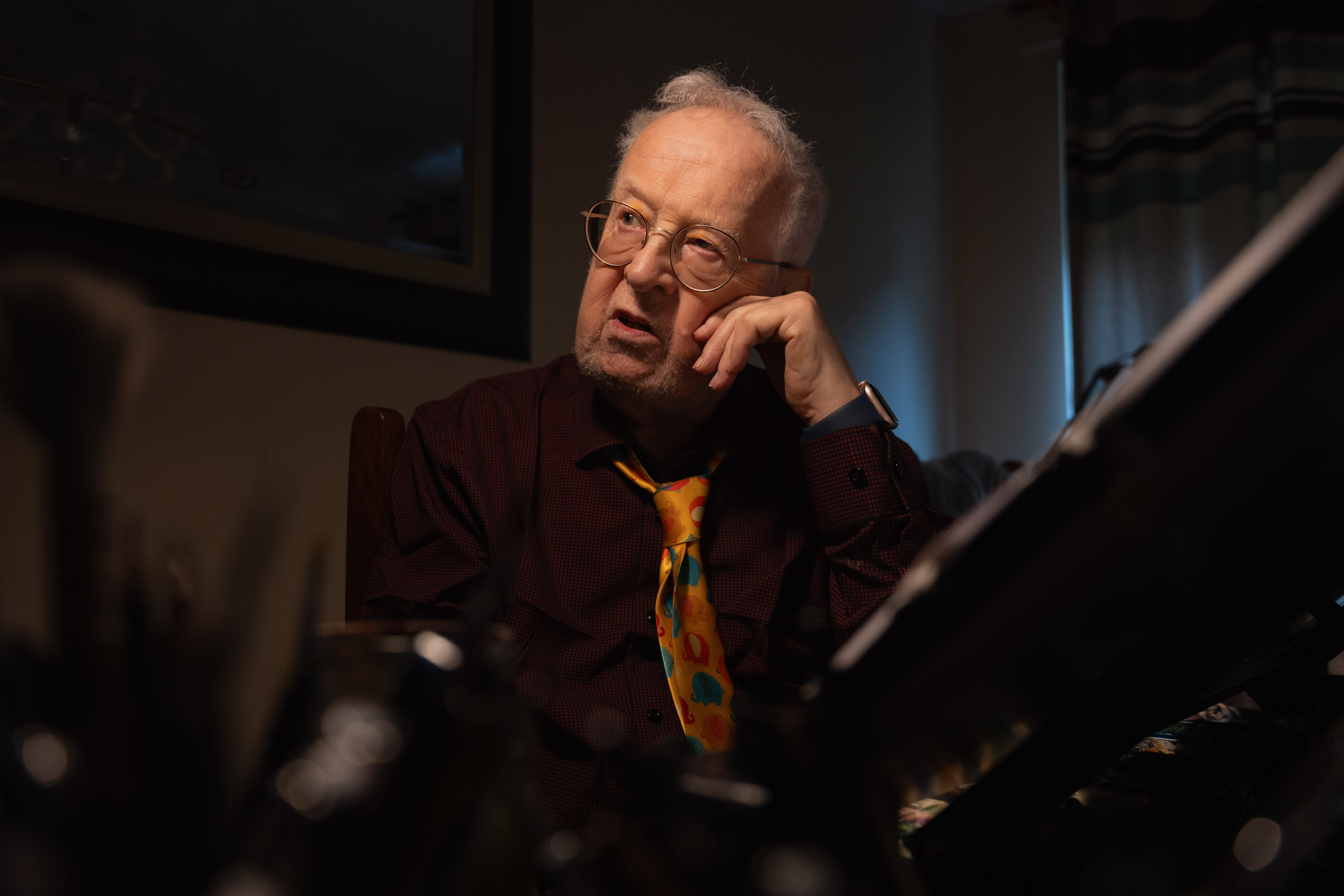
An older gentleman in a quirky yellow tie patterned with elephants, set neatly against the elegance of his suit and shirt, Edward Chisnall is a visual storyteller of Glasgow.
Last year, Chisnall donated to Glasgow City a print titled Ghlaschu 850, a fine art commemorative work created to mark the city’s 850th anniversary. It is a detailed painting which he describes as “a love letter to Glasgow, a city of invention, resilience and humour.”

Credit: Jason Fong / Strathclyde Telegraph
The original piece, capturing the beauty of the city we know and love, its rich history told through its buildings, hangs above a sofa in his living room in Bearsden. The space is filled with Chisnall’s artwork, alongside photographs and memorabilia. But it is not a room set apart from his practice; instead, it feels lived-in by it, as if the boundaries between home, archive and studio quietly dissolve.
The living room extends into a dining room, or rather, his art studio. On the table, there is no vase of flowers or a neatly arranged dining set. Instead, a large easel stands among paints and brushes, illuminated by a desk lamp directed at the work in progress. It is a full artistic setup, and it is here that an illustrated history of Glasgow is being brought to life.

The project that Chisnall is currently working on is not a new direction, but a continuation. For decades, he has been telling the story of the city through radio, through books, and through painting. A graduate of the Glasgow School of Art, Chisnall has worked across disciplines as a painter, author and broadcaster, consistently returning to Glasgow as his subject.
Each page he creates carries not just images, but narratives: of people, of places, of a Glasgow that stretches from its earliest histories to its present day. Glasgow’s history unfolds as a series of living scenes, Viking ships on the Clyde, early bridges crossing the river, and the traditions of the Glasgow Fair, reimagined not as distant history, but as moments shaped by the people who lived through them. These illustrations reflect Chisnall’s interest in returning to “the beginnings, the origins.” “I’ve always felt connected to the past… wanted to know what happened before,” he says.
Hidden within the pages are details that reward a closer look: dialogue that reflects the changing nature of the Scots language over centuries, subtle shifts that speak to the depth of research and, more importantly, to a deep-rooted love for the city and its culture.
Chisnall’s life is not separate from the history he tells; it is woven into it.

In his earlier career as a radio broadcaster, Chisnall brought Glasgow to life in short, vivid segments, telling stories of its people and its streets.
His book Bell in the Tree: The Glasgow Story was broadcast daily on Radio Clyde in 1982 and 1990, bringing these stories into homes across the city and making Glasgow’s history part of everyday listening. His radio work went on to receive international acclaim, winning a gold medal in New York for the world’s best radio drama, an achievement he would repeat with a second series. A translated version, later broadcast in South America, brought further recognition, including the prestigious Ondas Award.
Reflecting on the awards, Chisnall says, “I must have been doing something right.”
Throughout the 1990s, his column, The Glasgow Story, ran in the Evening Times, blending historical detail with his own hand-drawn illustrations, which were often cut out, collected, and even used in schools.
Reflecting on that period, Chisnall says his intention was always to give the work a wider purpose: “I’ve always wanted to feel that there is a message, there’s my own conscience and my own perspective on life.”

Classically trained at the Glasgow School of Art, Chisnall’s work spans multiple techniques, from oil painting on canvas to gouache and beyond.
The projects he is currently working on, Chisnall explains, are largely built from drawing and layered painting: “That’s all pencil drawing really, and then painted in. I use gouache, watercolour mixed with white, but I also do line drawings and pen and wash.”
His approach has shifted over time, reflecting his life experience. “I think a lot of art is to do with knowing what to leave out,” he says. “My work has become more selective, more comfortable with empty space, with contrast, with different ways of seeing the same thing.”
Regardless of medium, his focus remains constant: Glasgow, and the stories embedded within it.
For Chisnall, that sense of storytelling is a way of seeing, shaped by curiosity and imagination. “It’s a kind of childlike view of life,” he says. “I like to see things around me, and people around me with a flavour of fantasy. When one is a child, you never know what’s around the next corner. It’s a sense of wonder… that is at the heart of art.”
As an adventurous student at the Glasgow School of Art, Chisnall was not simply observing the culture around him, but actively living it, climbing towers, causing mischief, and becoming part of the very artistic world he would later reflect on. These stories, humorous and chaotic, are not just anecdotes; they are fragments of a wider history, moments that belong to the cultural fabric of the city.

Chisnall is, undeniably, a part of Glasgow’s history. Through the people he knew, the spaces he inhabited, and the creative life he lived, he has both witnessed and contributed to the city’s evolving identity.
Even his time spent living abroad feeds back into that story. His experiences beyond Glasgow add new layers to how he understands and represents the city, because, as Glasgow’s own slogan says, “People make Glasgow.” Chisnall, shaped by both his travels and his roots, brings that expanded perspective into his work.
His stories stretch beyond the boundaries of the city, sometimes slipping into moments that seem to sit just outside ordinary explanation.
On one occasion in the south of France, as he wandered away to explore an ancient stone structure, he became disoriented and lost his way.
“What felt like five or ten minutes… people had been looking for me for over half an hour,” he says. “I think I had gone back in time.”
For Chisnall, the experience became something more than disorientation, a moment that shifted how he understands the world. “From that moment, I began to see things as possible,” he says.
Whether taken as memory, imagination, or something in between, the story, like his paintings, blurs the boundaries between history, myth and lived experience.
That sense of possibility, of life existing just beyond the edges of certainty, runs through Chisnall’s work, but it also reaches into something more personal.
He recalls a moment in his life when he was told he had died for five minutes following a sudden medical emergency. The experience, he says, did not resemble the images often associated with near-death accounts. “I didn’t see any tunnels or white lights or anything like that,” he explains. “I saw myself, and I thought I was stupid.”
What stayed with him was a perspective on life. “I think it gave me a sense of still having something to do,” he says. “That my work, or what I was supposed to be doing, wasn’t finished.”
Looking back on it now, he reflects on death not as something abstractly distant, but as something oddly unreal. “I danced with death,” he says simply.

For Chisnall, the experience did not produce fear so much as focus, a continued sense of movement, purpose, and creation. “My culture is afraid of death,” he reflects. “I don’t know if I am.”
Across radio waves, newspaper columns, books and painted canvases, Chisnall has spent decades documenting Glasgow’s story. Yet he is not just recording it; he carries it, shaped by the same city he has spent a lifetime portraying.
For Chisnall, creativity is not separate from life itself. “I am the process,” he says. “I can’t conceive of myself as existing without making things.”
In his home in Bearsden, brushes, paper and half-finished images spill from the dining table into the studio space without distinction, as though making and living are the same act.
In that constant act of creation, if people make Glasgow, then Chisnall is one of those still making it.

Hi, I am Julia Braun Raven, an award-winning student journalist, having been named Arts Writer of the Year at the Herald Student Press Awards 2026. Following this achievement, I am continuing to develop my journalistic skills and contribute to The Herald’s arts and culture section under the mentorship of Arts Correspondent Brian Ferguson.
I am a third-year Journalism, Media & Communication and English & Creative Writing student. I was re-elected as Editor-in-Chief of the Strathclyde Telegraph for 2026/27. Alongside preparing for the new academic year, I am delighted to continue working with the team to create a student newspaper that reflects student life on campus, while also covering the wider issues shaping the world around us.
Leave a Reply