
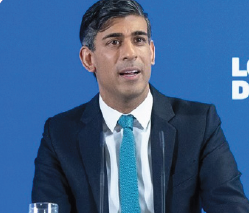
October 25th marked a year to the day since Rishi Sunak was appointed Prime Minister, in the wake of a chaotic Liz Truss administration which saw the Conservatives sink to record lows in the polls. Coming into power at the time of the cost of living crisis becoming a household term, Sunak has consequently been faced with a range of economic issues domestically, as well as having to deal with foreign policy issues including Ukraine and Israel-Palestine.
On the domestic front, a series of labour strikes have occurred since the summer of 2022, following the much-publicised RMT strikes. As well as rail workers, other prominent unions have gone on strike, including teachers, postal workers and healthcare staff. In response to increasing industrial action, Sunak’s Conservative government introduced the highly controversial Strikes Bill, also known as the “Minimum Service Levels” Act. The act proposes to ensure public services maintain a certain level of efficiency, regardless of strike action. This could serve to essentially halt workers from striking as the nature of strike action means that services have to be negatively impacted in order to incite a response from the state. Preventing this will almost certainly put a stop to certain workers striking. The act has even been criticised as breaching international law, potentially clashing with the European Convention on Human Rights framework on the rights of association for workers. Nonetheless, it passed through Parliament and received Royal Assent in July of this year. Sunak himself also recently attracted criticism for blaming striking doctors for rising NHS waiting times.
The start of October saw Sunak make a major change to the highly controversial HS2 rail line, cancelling the northern leg of the line which would have connected Birmingham and Manchester. This meant that the project, which had already been significantly reduced since being introduced in 2013 by then PM David Cameron, will only run between London and Birmingham. Whilst a somewhat unsurprising move given the rising costs of the project, it would seem to exclude the north of the country from vital infrastructure work, and it remains to be seen what the government will do to account for this loss. Despite rhetorical support for state intervention to help working families tackle the cost of living crisis, Sunak’s responses to strike action and HS2 costs indicate a hesitance to invest both in improving working conditions and infrastructure.
On foreign policy, Sunak has continued the stance of predecessors Boris Johnson and Truss in unequivocal support for Ukraine in its ongoing conflict with Russia, this summer pledging £2.35 billion in financial support by way of bank loans towards the country’s rebuild. Sunak announced the support at a global summit, where he also proposed to support Ukraine for “as long as it takes” when it comes to their ongoing war with Russia. The guarantees were said by Downing Street to be the first bilateral package of multi-year fiscal assistance, towards Ukraine coming from a G7 country, highlighting the extent of the UK’s support for the nation.
Sunak’s premiership has also coincided with the recent flare-up in the Israel-Palestine conflict, which has been the most significant escalation in the long-running conflict this century and resulted in the deaths of over 15,000 Palestinians. Though he set out £20 million towards the humanitarian crisis in Gaza at the end of October and voiced support for a two-state solution, he has largely continued the UK policy of supporting Israel and the military action it takes. Immediately following the escalation, Sunak, in a joint address with Israel PM Benjamin Netanyahu, stated the UK supports Israel’s “right to defend itself in line with international law” and claimed that Israel is taking “every precaution to avoid harming civilians”. Israeli settlements on Palestinian land are illegal under international law and the country has also been widely criticised for failing to take necessary precautions to avoid harming Palestinian civilians.
Though with signs of improvements from the lows of Liz Truss, the Conservative party still lags well behind Labour in the polls, and on both domestic and foreign policy Sunak has largely continued the principles of his predecessors. Continuing controversies among Conservative politicians haven’t helped, with bullying allegations leading to prominent resignations from Gavin Williamson and Dominic Raab, and Sunak himself recently accused at a COVID inquiry hearing of saying the government should “just let people die” instead of imposing a second lockdown.
After a year of Rishi Sunak in charge, it is still difficult to see the Conservatives challenging Labour at the next election, and Sunak himself may come under increasing pressure from a party with a track record of changing leaders in recent years.
Leave a Reply