
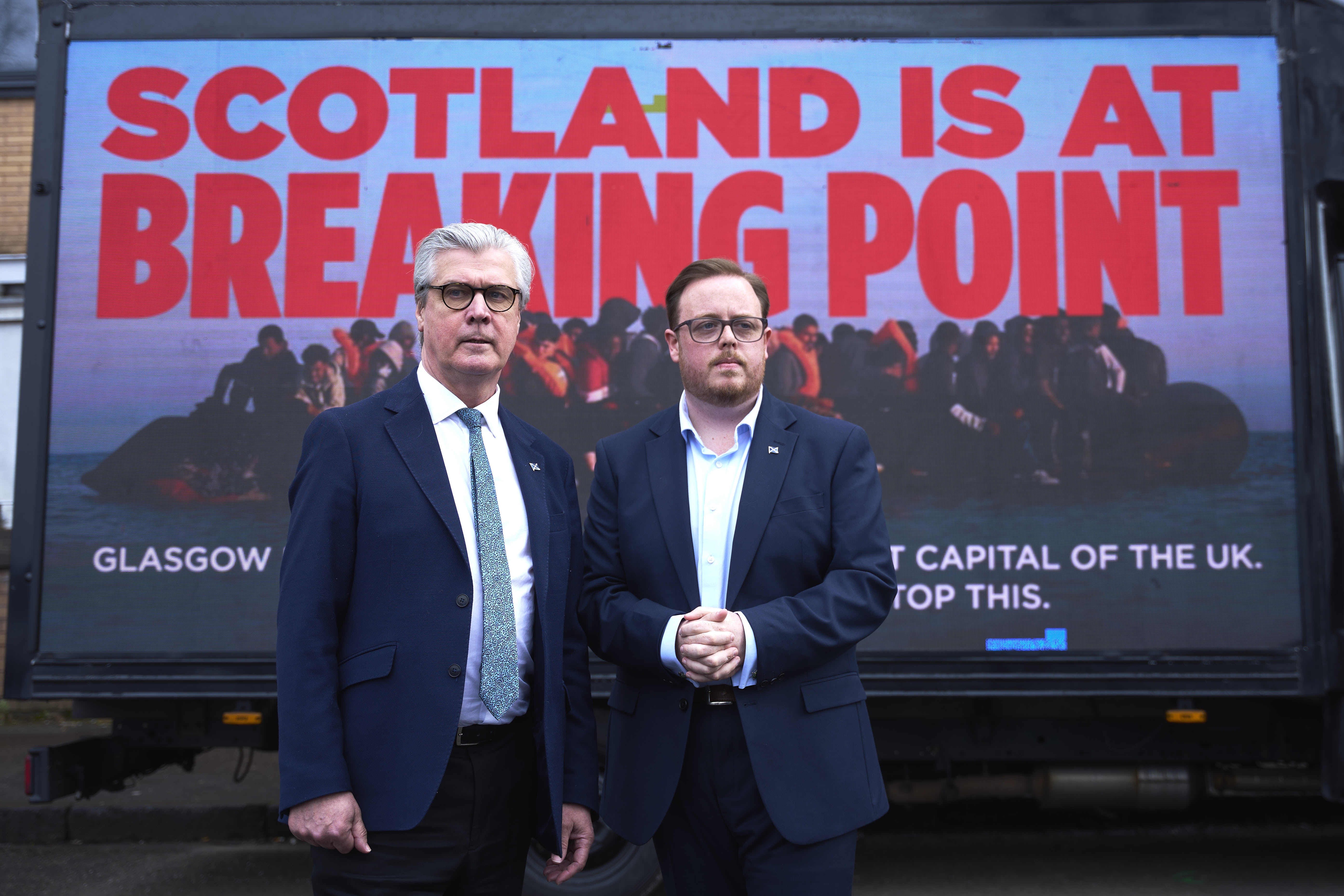
Reform UK’s Scotland leader, Malcolm Offord (L) and Holyrood candidate Thomas Kerr (R)
Credit: Jason Fong / Strathclyde Telegraph
I met Thomas Kerr, the Reform councillor for Glasgow Shettleston and the MSP candidate for the Ballieston and Shettleston constituency, at a Reform press conference. We had arranged to conduct an interview before the conference. The event was to unveil their new campaign van, a black vehicle with a low-quality screen that read “SCOTLAND IS AT BREAKING POINT” in red text alongside an image of dozens of people crammed onto a small boat crossing the channel. Crucially, it’s important to note that small boat Channel crossings don’t come to shore in Scotland.
Inside Tollcross International Swimming Centre, I waited for half an hour after our arranged meeting time, occasionally seeing Kerr loitering in the car park with Scottish Reform Party leader Malcolm Offord. After the conference, which was also late, we finally sat down for our interview.

Credit: Jason Fong / Strathclyde Telegraph
We started by discussing the controversies that had marked the first few weeks of Reform’s Scottish campaign. From suspensions, infighting and offensive jokes, Reform’s campaign has been riddled with what Kerr describes as “teething problems for a new party”.
Malcom Offord had been under intense criticism for his homophobic ‘joke’ about George Michael, with John Swinney commenting that it was a “warning to this country of what is coming our way”. Kerr casually brought this joke up early in our conversation: “I was out on Saturday campaigning at Parkhead. We had a big street stall, and I was amazed by how many people wanted to bring up the joke situation”.
Kerr reflected that “people were saying the opposite, they were saying it’s a shame that a joke he said years ago is being dredged up. I think these sorts of issues don’t derail a campaign”.
Kerr’s tone turned serious when I asked him if he himself found the joke funny.
“No, I think the joke was offensive.”

Credit: Jason Fong / Strathclyde Telegraph
Discussing further the public’s responses on the doorstep, Kerr feels “pretty upbeat” about the direction of the campaign. This is despite polling in third place behind the SNP and Labour in the area, according to a Ballot Box Scotland Poll.
“I don’t pay attention to polls, I pay attention to the feeling we get on the street, and the feeling I get in Shettleston and the East End of Glasgow in particular is very, very positive. I have people who come up to me now who want to speak to me and ask me for pictures, people who want to thank me. I’ve never had that as a councillor; I’ve been a councillor for 10 years and I’ve never had this kind of reaction.”
Thomas Kerr was previously a member of the Conservative Party, labelled a “rising star”, elected as a Tory councillor in 2017. In 2025, Thomas defected to the Reform Party and was, at the time, the most high profile defection in Scotland, Nigel Farage commenting that he was “delighted” to welcome him.
Kerr reflects that the main reason for his leaving the Conservatives was when he wrote to James Cleverly, who was the home secretary, “about the asylum crisis in Glasgow because I had been asked to. I didn’t get a reply, so I said I have had enough”. Kerr received a lot of criticism for his defection, with the Tory consensus being that he had defected for a better chance of being elected into Holyrood.

Credit: Jason Fong / Strathclyde Telegraph
Kerr believes he “joined Reform when it was still taboo to join Reform […] I was the first prominent person to make that switch, I stuck my neck out, and I got a lot of criticism from people in the Tories who I had considered friends; they abandoned me overnight”.
I pushed back, “Is it still not taboo?”
“It’s not as taboo as you think; you can see it in the people we have running as candidates and the people I’ve spoken to on the streets. It might still be taboo to some elements of society, Aimee Alexander, who’s standing for Glasgow Kelvin, will, I’m sure, get a worse response on Byers Road than I will in Shettleston. I understand that Reform is controversial, but I think politics has to be controversial; it has to be about poking the beast and opening debates about big issues.”
Kerr believes that “Scottish politics has gotten really, really lazy and we want to bring a bold, ambitious program to show the people of Scotland what it is we stand for. Some people will disagree with it, that’s politics, that’s democracy, but what I can say is that I am very confident that people in Scotland will look at Reform and see that we’ve made a campaign that was pretty boring, pretty exciting and it’s because we are challenging the status quo”.
As a former long-time member of the Conservative party, alongside Malcolm Offord, a former Conservative donor and Lord, some would argue if they aren’t the status quo of politics, then who is?
“I wear it on my sleeve that I am a former conservative […] We are former conservative party members but were not a part of the political class, so to speak”.

Credit: Jason Fong / Strathclyde Telegraph
Kerr reiterated the central message of the press conference: Reform does not hate immigrants; it is angry at the “political class” for encouraging them to come to Glasgow. This is some pretty hypocritical backpedalling from the party, possibly attempting to distance the party from its labelling as a racist party.
“We’re not demonising the people who have used the rules to get here; those refugees who have come here are using the means that the government has given them. We have a soft touch approach to immigration here.”
“I don’t blame people using this to better themselves and their families […] It’s the political class I have an issue with, who have taken communities like [Shettleston] for granted.”
Despite claiming not to demonise people or sew division in communities in Glasgow, Reform have used dog whistle terms like “fighting-aged men” and “strangers” when describing migrants. Asking Kerr why he deems it appropriate to use this charged language, he states that “fighting-age for me sums up that sort of person that’s in their mid to late 20s. I don’t see it as being divisive, I see it as speaking about the issue that many of the politicians are trying to hide away from”.
Immigration is the central issue for Reform, appearing on their campaign van and as their main talking points in the streets or at press conferences. This is despite immigration being an issue reserved for Westminster and, therefore, the Scottish elections will have little impact on immigration regulations here. Scottish Reform’s continued focus on immigration suggests that this emphasis may be intended to exploit racial tensions and appeal to voters with prejudicial views rather than to enact any real change in Glasgow.

Finally, I asked how he’d respond to the criticism that Reform aligns itself with far-right views and political actors like Tommy Robinson. Subsequent to our interview, Malcolm Offord has been urging party members to refrain from endorsing Robinson.
“I take issue with the far right, I don’t see reform as the far right or to the hard right at all, I see reform as being a centre-right party that is speaking about an issue that a vast majority of the public is speaking about, which is illegal immigration.”
Kerr believes that the party is speaking out on issues that, if left to stagnate in secret, would cause a greater surge in division and violence.

Credit: Jason Fong / Strathclyde Telegraph
“When you don’t speak about issues like immigration in the way reform does, it gets hidden, and you get people like Tommy Robinson who try to exploit these issues for political gain. I don’t see reform as the party that’s causing division; there are people like Zia Yusuf who use their voice to speak about immigration in a calm, measured way”
Despite denouncing Tommy Robinson, as is Malcom Offord’s wish, Kerr has previously promoted Robinson’s far-right conspiracy theories. Misinformation regarding a violent incident at Bellahouston Academy was spread by Robinson, who claimed that an “asian gang” was responsible, leading to the school and teachers receiving abuse. Both Kerr and Robinson reposted the same video, sharing this false claim.
“[Tommy Robinson] is right on certain things he’s spoken about, he was very vocal about grooming gangs […] That doesn’t mean I agree with everything he says. I think some of his language is deliberately used to try to sow division in society in a way I would never do”
Kerr doesn’t “want to see people like that in mainstream politics” and sees “Nigel Farage as a far more moderate voice. I don’t see reform as this divisive party that has caused a surge in racism since we’ve been around, were giving people a democratic route to say enough is enough.”

The Bellahouston Academy incident was cited alongside numerous rape incidents discussed by Kerr in his press conference speech. Almost all of the cited incidents are described through the context of their race. I asked why he has focused so heavily on cases of rape which involved non-white or non-Scottish offenders, considering the most predominant perpetrators of rape in Scotland are white British men.
“The vast majority of people who do these sorts of crimes are people who are born in this country, who are white Scottish men. That’s the predominance of people that are doing this […] the reason I use the examples I used when I was speaking is that it’s in the context of the immigration crisis.”
The Reform Party is in close competition with Labour for second place, with only 9 days to go before the election. According to PollCheck, Reform could just beat Labour by 0.6%, but this could easily change when undecided voters go to the polls. Since our interview, Kerr has remained in the news, constantly surrounded by controversy, from ‘cronyism’ allegations for appointing his partner as Reform’s press officer and a heated immigration debate with SNP’s Christine Jardine on BBC Scotland.

She/Her
Leave a Reply