
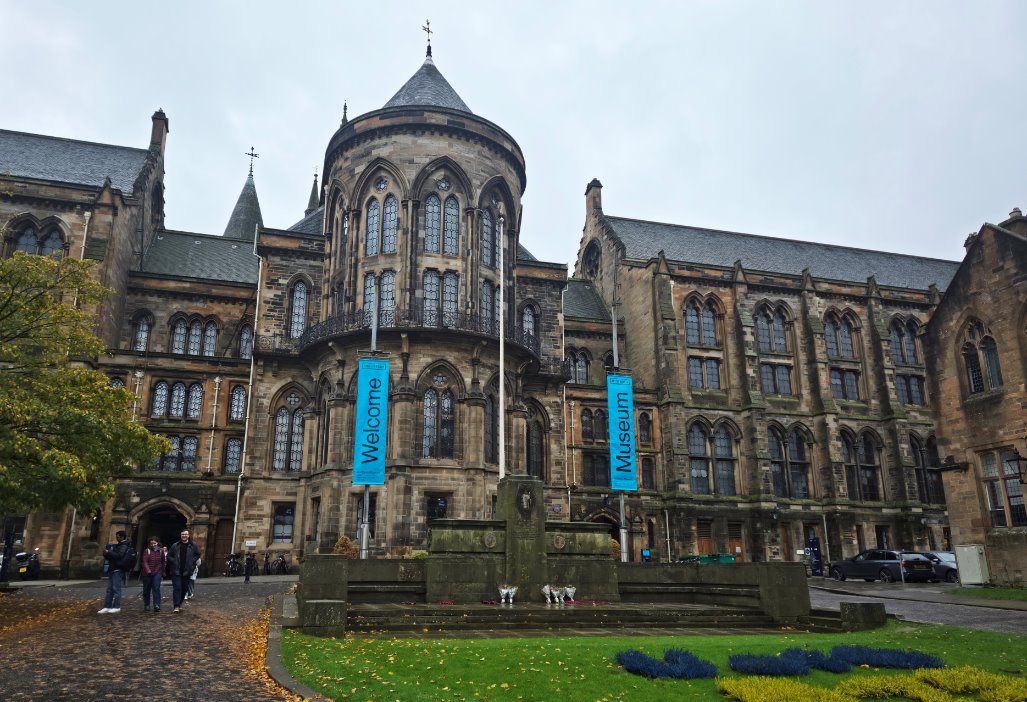
Black History Month’s annual exhibition, It Wisnae Us: The Truth About Glasgow and Slavery, is visiting The Hunterian Museum for the first time.
The Coalition for Racial Equality and Rights (CRER) introduced the exhibition in 2012, and it continues to address Scotland’s role in empire and enslavement as a permanent part of its programme.
Amy Rich, Communities and Campaigns officer at CRER, said: “There is still a common myth that Scotland and Scottish people weren’t involved in slavery… It is important for the It Wisnae Us exhibition to exist to continue to counter this narrative and raise awareness of the historical research that shows slavery was instrumental to the growth of Scotland and of Glasgow specifically.”

Inspired by Dr Stephen Mullen’s book under the same title, It Wisnae Us translates to It Wasn’t Us and brings to light how Georgian Glasgow benefited from transatlantic slavery.
“The geography of the city always reflects the imprint of the wealthy men who were involved in slavery… the city essentially moved west because rich plantation owners had a billionaire’s row of massive mansions,” said Graham Campbell, SNP Councillor for Springburn and Robroyston.
An example of that is a 18th century mansion house of a plantation owner, William Cunninghame, which, after his death, became part of the Royal Bank of Scotland, and in 1996, was turned into today’s Glasgow Gallery of Modern Art (GoMA).

“I hope people will look at their buildings, at their street names, and really ponder; properly look at it, see it for the first time,” said SNP councillor.
Scottish exceptionalism means that although cities such as Bristol, Liverpool and London were connected to slavery and the empire, Glasgow wasn’t associated with it.
“It was an organised forgetting,” added Campbell.
Through Dr Mullen’s book and subsequent commissions, including those examining the connections of Glasgow University and the University of Strathclyde to the transatlantic slave trade in 2018 and 2023, respectively, Glasgow began the process of recognition and redress.
Slavery, says Campbell, “was a unique innovation in history which we didn’t have before then, we haven’t had since, which was deliberately designed to destroy African lives.
“15 million people were kidnapped, made property, made things… that system was based on their economic exploitation.
“Mass murder, let’s put it bluntly.”

Glasgow’s wealth, the buildings we admire today, the streets we walk, Buchanan Street, named after Andrew Buchanan, Glassford Street after John Glassford, Ingram Street after Archibald Ingram, to name a few, were built at the cost of human life.
“What slavery does it denude your society of people… of resources and talent, which are instead used to build another,” says Campbell.
“We’re living in a world in which the legacy of slavery and colonisation still works.
“The racial ideology… People’s thoughts about black people and about African people are profoundly influenced by these anciently held but creative tropes and stereotypes which come from that period of Scottish enlightenment,” he adds.
Rich who works with communities across Glasgow and Scotland to protect the rights of Black and minority ethnic communities says: “The system of transatlantic slavery was justified by ideas around scientific racism and eugenics, ideas which continue to influence today’s understanding of race and mean we are left with a system of white supremacy that continues to mean poorer outcomes across education, employment, healthcare and more for Black and minority ethnic people.”
Campbell, who is of Jamaican descent and in 2017 was elected as the first African Caribbean councillor in Glasgow, says: “It’s important that history is seen in academic places… but it needs to be seen out there in the streets so that ordinary citizens know about these connections.”
Previously displayed at the Kelvingrove Art Gallery and Museum, St Mungo Museum, Burrell Collection and the City Chambers, It Wisnae Us each year moves between different Glasgow locations, which, says Rich, changes the audience and “the ways in which it is interpreted.”

Graham Campbell, who would like to see It Wisnae Us as a permanent exhibition, said: “It’s very fitting” that this exhibition is displayed in Glasgow University buildings.
“Many of the bequests for this building were donations from wealthy benefactors with tobacco, cotton, textile, sugar, and a financial background which were linked to slavery.”
“Unlearning it is not going to be a quick process, but part of telling a true history and having exhibitions like this, we start that story. We start people questioning, well, what does it mean to be a Scot today? What does it mean to be British today?”

Hi, I am Julia Braun Raven, an award-winning student journalist, having been named Arts Writer of the Year at the Herald Student Press Awards 2026. Following this achievement, I am continuing to develop my journalistic skills and contribute to The Herald’s arts and culture section under the mentorship of Arts Correspondent Brian Ferguson.
I am a third-year Journalism, Media & Communication and English & Creative Writing student. I was re-elected as Editor-in-Chief of the Strathclyde Telegraph for 2026/27. Alongside preparing for the new academic year, I am delighted to continue working with the team to create a student newspaper that reflects student life on campus, while also covering the wider issues shaping the world around us.
Leave a Reply