
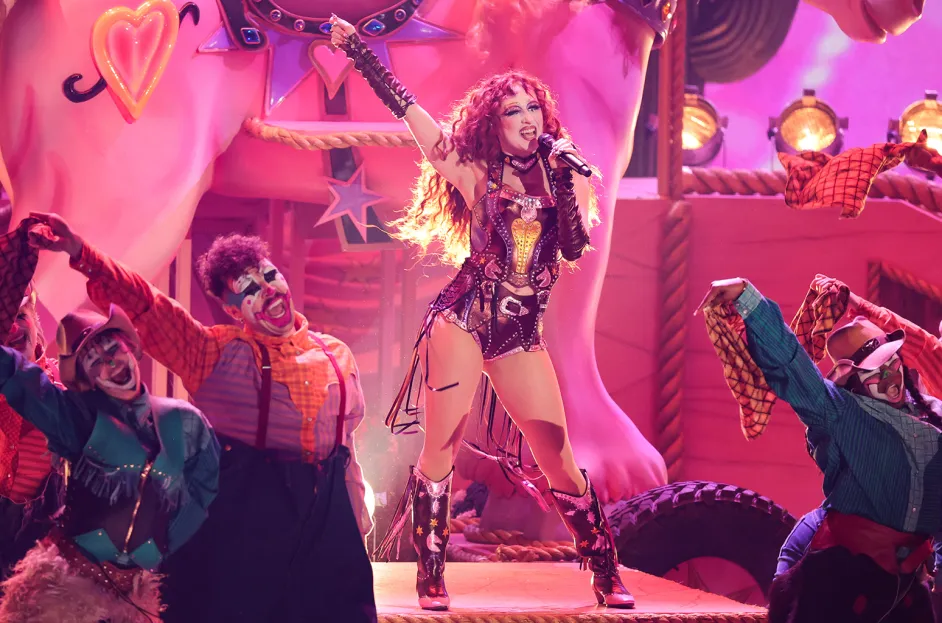
The 67th GRAMMY Awards ceremony took place on 2 February and was a remarkable night for queer musicians. Chappell Roan was awarded her first GRAMMY for ‘Best New Artist’, Billie Eilish was nominated in three out of the ‘Big Four’ categories, Doechii won ‘Best Rap Album’ and Lady Gaga won ‘Best Pop Duo’ alongside Bruno Mars. Having queer celebrities at the forefront of mainstream music, and to be awarded with prestigious awards like ‘Best New Artist’, is increasingly important for young fans to feel represented in pop culture.
Despite her 10-year career in the music industry, Roan is now only just receiving her flowers with her meteoric rise to stardom, and her recent GRAMMY win has only further cemented her presence in the spotlight. Before Roan there was, of course, queer music for queer women – the mind jumps to artists such as Phoebe Bridgers and boygenius – but Roan embodies a new spirit of queer music – a turn to something vibrant and fun.
In 2023, Roan released her debut album, The Rise and Fall of a Midwest Princess which features well-known hits such as ‘HOT TO GO!’ and ‘Pink Pony Club’. Throughout the past year, Roan has used her platform to uplift those in the community who deserve recognition and appreciation. On her tour, for example, Roan had local drag queens as support acts to show her thanks and respect, as much of Roan’s style inspiration originated from drag queens.
Representation for lesbians entered a new era in 2024. It was hailed the year of the “lesbian renaissance” giving way to a new, bold and unashamed attitude towards lesbian representation. Early last year Roan confirmed that she identified as a lesbian, around the same time that another artist, Reneé Rapp, also opened up about her lesbian identity. Having open lesbians at the front of pop music is exceedingly important representation for young lesbians and also instrumental in removing the stigma surrounding the word ‘lesbian’ more generally.
Quoted on Stonewall’s website Cat Dixon, the Chair of Trustees, discussed the importance of representation for lesbians: “Representation matters because it validates our existence, our experiences, and our identities. When we see other lesbians and others from the GBTQ+ community being visible and unapologetic, it sends a powerful message that we are not alone, that we are part of a vibrant and diverse community. Representation also challenges stereotypes and misconceptions about lesbians, showing the world that we come in all shapes, sizes, and colours.”
BBC’s I Kissed A Girl (a sapphic reality TV show) included a raw conversation discussing the relatively new shame surrounding the word “lesbian” that some of the contestants struggled with. The open conversation regarding the lack of representation (that the show is now allowing for) is also important in highlighting the importance of representation in popular culture and media for young lesbians.
Throughout queer history lesbians, in particular, have been at the forefront of historic queer liberation movements. In the 60s during the Stonewall riots it is believed that Stormé DeLarverie, a butch lesbian, was an instrumental match in igniting the first riots. Additionally, during the AIDS crisis in the 1980s, lesbians banded together to donate blood after gay men were banned to ‘stop the spread of HIV’. A group called the ‘Blood Sisters’ was formed by lesbians, and the blood drives they organised ran throughout the 80s and into the 90s. When looking back on LGBTQ+ history, such as these examples, it shows the value of community. It also demonstrates need for an emphasis on solidarity now, to ensure the survival of the community as a whole.
On 20 January Trump was reinaugurated as President and has since introduced a slew of executive orders in regards to ‘defending women from gender ideology extremism.’ As a result, the mention of transgender people and intersex people was removed from a number of federal websites, including a page on the State Department changed from information for “LGBTQI Travelers” to now only “LGB Travelers”, as well as a different page changing from “Resources for LGBTQI+ Prospective Adoptive Parents” to “LGB Prospective Adoptive Parents.” This type of language and decision making is extremely exclusionary and pushes harmful opinions of trans people. These kind of conservative policy decisions highlight the importance and necessity of representation for minority groups.
The concept of being transgender has existed long before the term itself was coined in 1965. It was in 1906 that Karl M. Baer became the first person to undergo a sex change surgery after an accident sent him to hospital, and his identity as “a man who was mistakenly identified as a woman” was therefore brought to medical attention. Baer received surgery and was issued a medical certificate to confirm his gender, which was authorized by the court the following year.
Another notable example in transgender history is Lili Elbe, who’s life and story were brought to life by Eddie Redmayne in the film The Danish Girl. Important also is Marsha P. Johnson. Johnson was a huge advocate for LGBTQ+ rights and was also a significant figure of the Stonewall Riots. She described herself as gay, transvestite and a drag queen. The term “transgender” only became commonplace after her death, but it is likely that she would be considered trans in today’s terminology.
These, among countless others, are proof of the long history of the existence of trans people and, although Trump may try, there is no possibility of erasing the existence of trans people or the history that is behind them.
This year’s GRAMMY awards, and its highlighting of queer talents in the music industry, couldn’t have been better timed with these current political happenings in the USA. In particular, Lady Gaga used her acceptance speech to make explicit mention of trans people by stating: “Trans people are not invisible. Trans people deserve love. The queer community deserves to be lifted up.” It is important that celebrities use their place in the spotlight to help and uplift those that don’t always get the chance to.
In an interview with Rolling Stone Magazine in 2024 Roan discussed being thrust into the spotlight and becoming a queer icon simultaneously, stating: “It’s so nice that people have started to take queer artists seriously outside of their queerness.” Having unapologetically queer artists succeeding in the music industry is important for younger audiences to know that they are valid and feel represented by people they look up to.
Artists like Roan, who is known for standing up for herself and setting her boundaries with fans and paparazzi alike, has the potential to influence young queer people (and lesbians more specifically) to better stand up for themselves.
Representation works both ways – it’s not just about visibility, but about breaking the outsider narrative. As Roan said, the more people see successful queer individuals, the less ‘shocking’ our existence becomes. Because, believe it or not, we’re not mythical creatures – we’re real, we’re here, and we’re thriving.

Fourth year English and Creative Writing Student.
Leave a Reply