
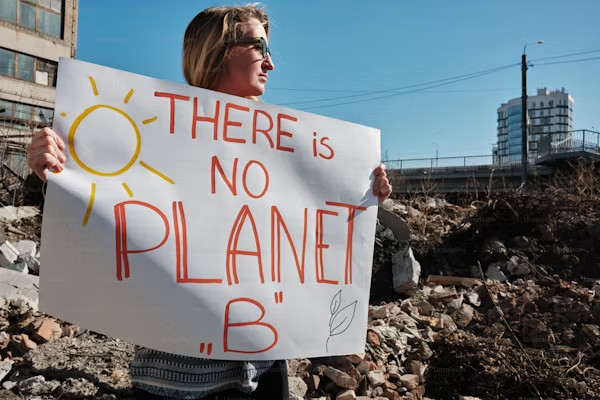
I first felt the now familiar pang of fear during the floods in the United Kingdom in 2012, sitting on my parent’s bed whilst my dad watched the news on his computer. At eight years old, I thought the world as we know it was ending and as I’ve grown older this feeling has followed me through each major environmental crisis. When it hit 40 degrees in London in 2022 it felt like I was being suffocated by the heat and fear, confined to my house keeping my dog draped in wet towels to keep her cool. Again, it felt like everything was changing and there was no way back.
The world record for the hottest day was broken twice in a week this summer in heatwaves across the world and hurricanes that have ravaged the south-east of The United States. With more extreme weather and wildfires raging across countries every summer, it can feel like the world is quite literally going up in flames. I have found myself increasingly exhibiting eco-anxiety; a phenomenon that is becoming increasingly prevalent as the effects of climate change become more glaring. It explains the emerging correlation between climate change and poor mental health and is defined as a chronic fear of environmental doom.
A new study by The Guardian finds that 85% of American young people are “extremely worried” about climate change and 52% agreed with the statement “I am hesitant to have children”. However, eco-anxiety is not just reserved for young people. If I was feeling existential dread at the age of eight, how are those immersed in the statistics, researching the planets’ decline every day, feeling? Am I catastrophising or are scientists feeling the same?
Those researching climate change are facing difficulty due to the nature of their work, having to face the overwhelming evidence of the planet’s decline on a daily basis. In addition, they are feeling ignored or scrutinised for protesting – which has created a stigma towards them and the crisis. Their work is affecting their personal lives and has even stopped many from choosing to have children out of fear for their future.
In speaking to Peter Kalmus, a climate scientist at NASA’s jet propulsion lab and writer as well as a protestor who has been arrested whilst at demonstrations, he claims that it has had “a negative effect” on his mental health and “causes a huge amount of concern for the younger generations.”
Kalmus has been very open on how desperate the situation is after a video of him overwhelmed by emotion at a climate protest outside of the JPMorgan Chase Building went viral. The vulnerability shown in the clip resonated with viewers and conveyed the mental toll of the situation. He says he is: “confident that the vast majority of people, even highly educated people, even public officials, have no clue how bad things are going to get, and how widespread and all-encompassing the impacts to our society, lives, stability, food systems, etc. it will be.”
‘Climate optimism’ is a trend online and on the news which involves an approach to climate change prevention that is more optimistic and often highlights small achievements made in the fight against climate change. I asked Kalmus how he thought ‘climate optimism’ was affecting the movement, he believes that: “there’s a lot of toxic climate optimism from people who truly don’t understand the intensity of the stuff coming down the pipe in the next few decades and beyond.
He went on: “Optimism is important but it needs to be grounded in reality, not denial. Unfortunately, though, toxic optimism is reassuring and makes people peddling it popular. Optimism is toxic if it makes it easier to check out, and not make a meaningful difference.”
Kalmus highlights that a truly healthy and grounded approach to activism is one that encourages people to take meaningful action, even when it involves personal risks. He argues that the willingness to face challenges—whether it’s the risk of arrest, losing one’s job, or being ostracised—is essential for making a genuine impact. Kalmus underlines the power of individuals coming together, suggesting that such risks, when shared and united by a common purpose, can lead to collective action capable of driving lasting change.
Whilst sharing his fear for the future, Kalmus reveals that he has had to learn to develop healthier ways to deal with the stress, such as “running, meditation, and therapy”.
Professor Stuart Haszeldine is a geologist and environmental scientist at the University of Edinburgh, who believes that his colleagues share his anxiety and concern for the younger generation. He told me that “we can try mitigation actions, but the heating and changes for the upcoming years to 2040 and 2045 are pretty much inevitable”.
The figure of 1.5 degrees Celsius has become common knowledge as the target limit for temperature increase, however, Haszeldine believes “a combination of past emissions with unchanged behaviour means that there are more than enough emissions to drive the world well beyond two degrees Celsius average heating”.
He says he has seen that: “amongst teenagers and 20-somethings there is certainly verbalisation that the future looks bleak. And that even extends to comments that they may not themselves want to produce children.”
Haszeldine tells me that he and his colleagues are constantly asking “why is it so difficult and protracted to gain research funds? Why is progress so slow? If this is a climate emergency, what does a “real” emergency look like? Does anybody realise that an overshoot of temperature cannot be remediated as extinct species cannot be re-invented?”.
Speaking to Anne-Marte Bergseng, who is currently working on a research project looking at the impact of climate change on mental health and the most effective intervention strategies for ClimateXChange. Asking if she has felt anxiety or concern for the younger generations she replied, “yes, the pace of reducing emissions is far too slow and I feel guilt and shame that we have not taken stronger and earlier action”. Bergseng is a member of The Green Team whose aim is to connect young people with nature and provide an environmental education.
Finally, I spoke to Professor Jamie Toney who is the Director of the Centre for Sustainable Solutions and a Professor of Environmental and Climate Science at the University of Glasgow. Jamie tells me that her “current research is about working with people (i.e., communities, public sector, private sector, and third sector partners) to take a systems approach to a just and sustainable future. Reshaping my work has allowed me to have hope and not be negatively affected in terms of my mental health.”
I asked how she felt about the stigma surrounding climate change as there is a growing hatred for organisations such as Just Stop Oil and she replied: “I have had colleagues who have been adversely affected – (especially in the U.S.) who have been physically threatened and have had threats against their lives by advocating from their research to stop fossil fuel extraction, etc.”
Guilt was something that all the interviewees resonated with. Despite being within a group of people who are arguably doing the most to prevent a climate catastrophe, there is a sense that they are still not doing enough. According to a recent report by The World Economic Forum, it is predicted that by 2050, Climate Change could result in an additional 14.5 million deaths. This makes it impossible to ignore and yet it repeatedly is.
Last month two Just Stop Oil members were sentenced to two years in prison after their viral protest in which they threw soup on a Van Gogh painting. In July a record sentence of five years was given to a protester for planning a demonstration. With scientists dedicating their lives to the preservation of humanity, at the cost of their mental health, and protesters sacrificing their freedom, doesn’t society owe it to them to at least listen?
I have taken Peter Kalmus’s advice and tried to control my climate anxiety with exercise and meditation however I cannot help but feel that this fear is a natural reaction to the destruction of the planet. Vulnerability from scientists could be used as an effective tool for change as the public’s response to other forms of protest has been overwhelmingly negative.

She/Her
Leave a Reply