
By Kulsum Shabbir
As exam season tension eases into early May, students around the world breathe a sigh of relief. Finally, the dust has settled, marking the end of another academic year. However, for some, on-campus living has only just begun.
Around the world, students have gathered to protest on their campus grounds. Their objective: to urge their universities to divest from Israeli companies and stop funding weapons that are aiding the ongoing genocide in Palestine.
The student protests at New York University and Columbia University have drawn particular media attention over the past month, as protesters began pitching tents and setting up a temporary encampment on campus to pressure their universities to meet their demands. In an admirable show of organisation and unity, students quickly allocated areas for various activities and seminars, as well as finding volunteers to provide food and drink for those in attendance. Shortly after the encampments were established, the protesters found themselves surrounded by the police, with over 100 students being arrested at NYU.
Never mind the unsettling threat of arrest hanging over their heads – for many students, there are still finals to study for. While the image of harrowed students hunched over a dim laptop screen is a nauseatingly familiar one, there is also something endearing about watching these same, familiar habits continue among a sea of neon orange and khaki green tents, surrounded by an overly enthusiastic police force. If anyone can juggle the pressures of academic life and protesting against genocide, it’s a stubborn twenty-something-year-old with a decade-old laptop and a lukewarm coffee.
That being said, these encampment protests did not simply begin out of nowhere. Students across the world have been protesting against their universities since October last year, calling for an immediate ceasefire in Gaza. However, after months of seeing zero change, these student protesters decided to take more drastic action.

Encampment protests are not new: in the 70s, over 40,000 protestors camped out in Washington, D.C. in protest against the USA’s involvement in the Vietnam War. In the 80s, students at Cornell University created a temporary encampment to urge the university to divest from companies conducting business in apartheid South Africa.
What’s more, this method of protest has been proven to work. Most recently, Trinity College Dublin met with student protestors in the hopes of ending the encampment. The university said it has “initiated a process to divest from investments in companies that have activities in the Occupied Palestinian Territory and appear on the UN Blacklist”. While the students protesting here accept this as a partial win, they plan to continue their encampment until the university has fully divested from Israeli companies.
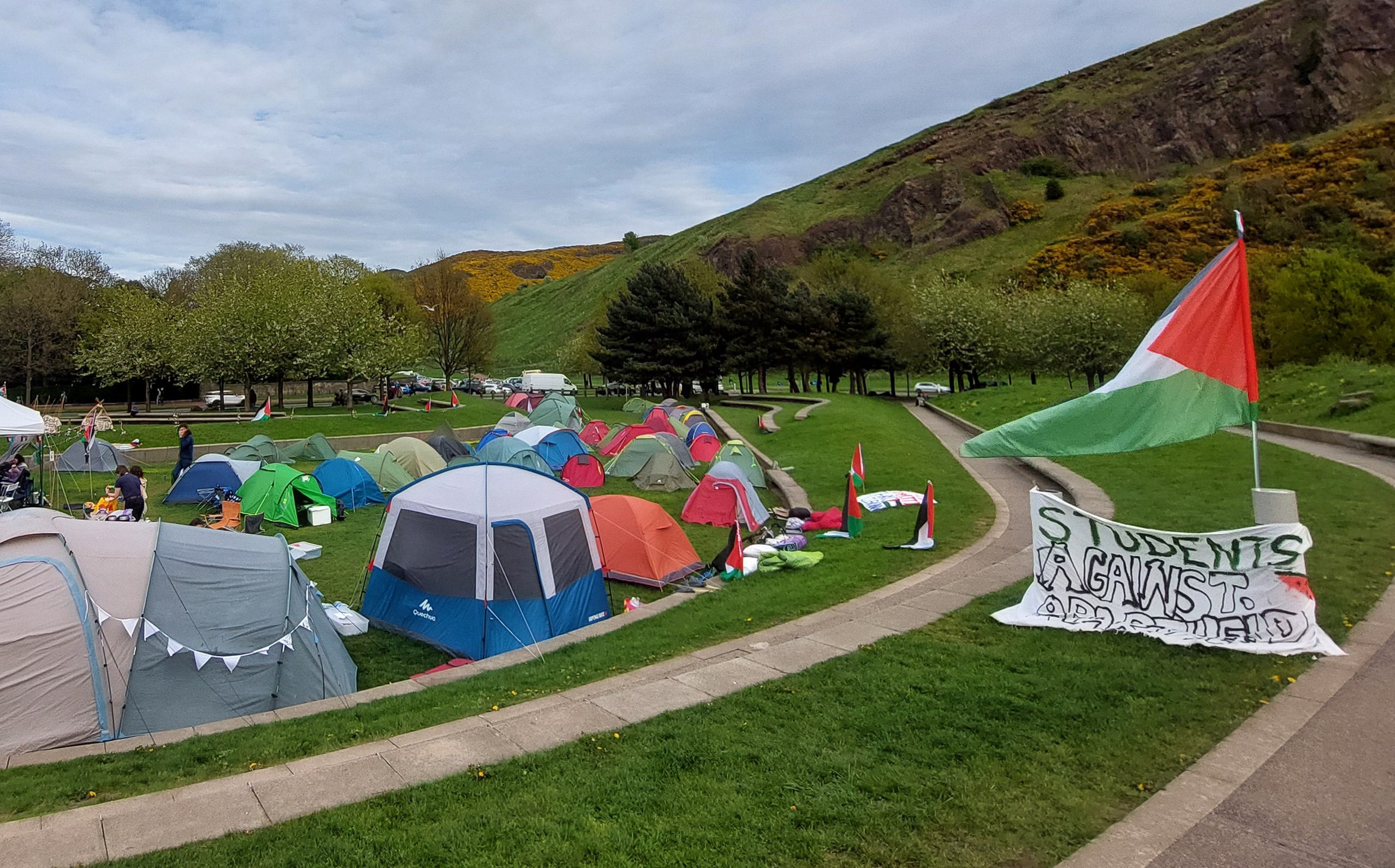
Student encampment protests have quickly spread across Europe, from Denmark to Italy to France, and now, to Scotland. University of Aberdeen and University of Edinburgh student protesters are getting involved by pitching their views, and their tents. While it’s still early days for these encampments, the students have quickly set up petitions and signs, exhibiting the same impressive organisation as their US counterparts.
Notably, the University of Edinburgh is the site where the Balfour Declaration, which unjustly signed away the land of Palestine, was first written in 1917. A group of students here have also begun a hunger strike, writing that they “refuse to uncritically benefit from education given to us by a university that has historically [and] so directly contributed to the colonisation of Palestine through its close ties with Lord Arthur Balfour.” Their statement continues: “We refuse to be made complicit by our silence in the [face of the] economic and academic support that our university gives to the illegitimate and genocidal state of Israel.”

It’s important to note that while Strath Union has made its support for Palestine clear – an obvious reflection of the views of its students – the university has yet to divest from arms companies. The Union has urged it’s students to support the encampments in Aberdeen and Edinburgh, and has called for the university to cut its ties with Israeli companies.
Both the University of Strathclyde and the University of Glasgow still invest in BAE systems, which manufacture the weapons used by the Israeli army in its militarised attacks on Palestine. The University of Glasgow has already seen many protests, particularly from the group Glasgow Against Arms and Fossil Fuels (GAFF), who have urged the university to “end its complicity in the ongoing genocide in Palestine” by divesting from all arms companies and prohibiting recruitment on campus.
It is unclear whether or not we will see student encampment protests set up at universities in Glasgow. To date, there has been no sign of any encampment protest plans.
You can check which universities are funding arms using this tool: https://palestinecampaign.org/university-complicity-database/

Creative Editor
Leave a Reply