
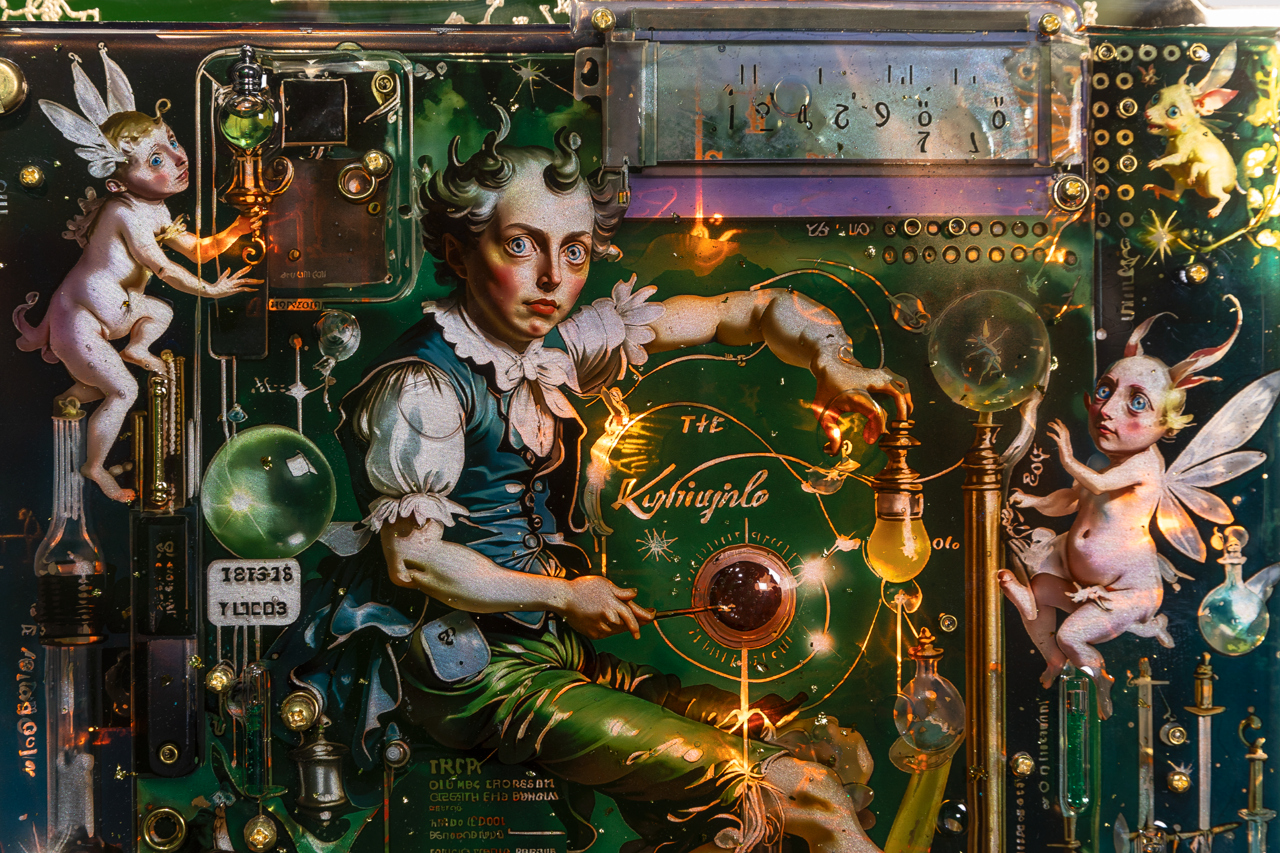
What does it mean to be creative in a time of rapidly expanding artificial intelligence? As generative tools such as ChatGPT or Midjourney become increasingly accessible, producing text, images and music at the click of a button, the boundaries between human and machine creativity appear less clear than ever.
For generative AI to produce an outcome, however, a human must first write a prompt, an instruction from which the system draws its response. Whether asking ChatGPT to write an email or using Midjourney to generate an image, the process begins with a human decision. Yet this raises a new question: who is the creator of the final work, and does distinguishing that really matter?
How much does authorship matter to the viewer?
In June 2025, Jemima Goodall, a machine learning engineer at Neophonic, specialising in speech and language, exhibited her installation at the exhibition AI Can’t Write Symphonies and Neither Can You. Commissioned by the Scottish AI Alliance, the show exhibited artists who were questioning the role of AI in art. Goodall’s installation, Death of the A(I)uthor, grew from a personal curiosity and marked her first interactive artwork.
Inspired by Roland Barthes’ essay The Death of the Author, Goodall’s installation presented a collection of AI-generated images. It invited viewers to record their impressions before learning the works were AI-produced, and again after discovering their origin. While Goodall describes herself as an “unprofessionally curious and creative human,” assumptions about who gets to claim artistic identity complicate the matter.

The installation created an opportunity for her to see whether knowledge of authorship alters perception and value.
“I wanted to get into the minds of other people and how they view art and their relationship to it,” she said, “and whether they really care about who made this piece of artwork.”
“There was a larger amount of people than I expected who didn’t really care if it was AI or not.”
What may come as an even bigger surprise is that some visitors even preferred the AI-generated pieces. For them, discovering the works’ origins did not diminish their experience.
In contrast, in January, the Glasgow City Council faced strong criticism after approving planning for a mural, the sketch for which had reportedly been designed with the use of AI. Headlines called the decision controversial and unacceptable. Comment sections filled quickly. The reaction felt sharp, even indignant.
Professor Sarah Cook of Museum Studies at the University of Glasgow was more cautious about reacting to the mural controversy.
“I have not made myself aware of this case in any detail because it looked to me like a clickbait headline,” said Cook.
“It looked to me like there was a discussion happening about drawing attention to something that wasn’t going to happen anyway.”
Goodall continued: “I think it’s very easy for people to villainise a piece of technology. Especially when it’s new. Especially when it’s overlapping in a domain where people think that it doesn’t belong.”
Is resistance to AI in art a defence of craft? A fear of replacement? Or simply discomfort with uncertainty?
“Whether it’s fear or whether it’s lack of awareness, not through anybody’s particular fault or choice,” said Cook, “there’s hype. When there’s hype, there’s a lack of clarity.”
Can art, which is uniquely positioned to help us look at an issue from a distance and through a different lens, the eye of the artist, offer that clarity?
Cook, who for over 25 years has worked with artists experimenting with new technology and exploring its effects on society and our relationships with one another, said: “AI is yet another technology in that long list of technologies that artists have both experimented with and made work about.”
Not so long ago, a similar panic followed the emergence of photography as a threat to art. Artwork that once could only be viewed in relation to the physical space in which it was displayed was now photographed and reproduced. With that shift, the audience changed. It became possible to look at art from around the world from the comfort of your home. Just like today, the appearance of new technology prompted a shift in the perception of what art is and the role of the artist, raising questions about authenticity and skill. Yet artists absorbed these technologies, questioned them, and transformed them.
As a Guest Professor in AI and Art subject at Umeå University in Sweden, together with Katarina Pierre, Cook is a curator of the exhibition AI and the Paradox of Agency at Umeå University.
Opened on March 13, the exhibition presents 19 artworks that consider our relationship to machines, automation and agency. It is a mixture of new commissions and previously shown works, some of which, as Cook says, “you may not describe as being part of the AI boom.”
The question of agency is not a simple one to answer.
“It’s not as simple as can a machine make art or are humans the only creative beings?” said Cook.
“The exhibition zooms out from that two-sided story to think about the role of societies, collectives of people and legal frameworks, or the role of nature, the world and the resources that are required.”
Agency, in this sense, is about control and responsibility. Who is actually acting in the creative process? Can there ever be AI-created artwork? Although it may appear autonomous, AI relies on human-made datasets, engineers who built it, institutions that fund it and the physical infrastructure that powers it. It also depends on the individual who types in a prompt.
Glasgow-based artist Rachel Maclean, whose artwork is displayed at the AI and the Paradox of Agency exhibition, has long used her own face and body to play every character in her films and installations. She has now trained AI models on that material, allowing the system to generate figures that look like her. In doing so, the AI seems to “run away” with her image because it has been trained entirely on her past work. As it is trained on Maclean’s previous work, it also runs away with the way she looks at the world.

Maclean’s work “is disrupting those long-held ideas we have about what an artist is and how they work and what they do,” said Cook.
The work becomes a collaboration between artist and model, raising questions about identity, replication and control. It is playful but disruptive. And it exposes the paradox: AI appears to introduce a new creative agent, yet it also reveals how creativity has always been shaped by systems, tools and structures beyond the individual.
The role of the artist in the process of learning about new technology is something we should consider before passing judgment on their work.
According to Alasdair Milne, a researcher at the University of Glasgow who works with Cook on the exhibition, criticism of AI in art also includes arguments about environmental impact and legal implications, including ownership and plagiarism. These are valid points that must be considered by artists as well as by society more broadly.
“We could consider art from a kind of societal perspective to be a special space that we maintain where we can do anything we want, free of constraint,” says Milne.
Art exhibitions are spaces where visitors have the opportunity to think about the world.
By commissioning artists to make work with AI tools, but also about AI and issues of agency, governance and regulation, the goal of the exhibition is to show that all of these things matter and that they will “help us be better informed about the world we’re living in.”
The role of artists has not fundamentally changed; they interpret the world around us, critically engage with it, and present it to us in a form that allows us to look at it from a different perspective.
What is important, as Goodall, Cook and Milne suggest, is creating a space for conversation.
As we search for answers about the validity of art created with AI, curiosity itself may prove to be the most important part of the creative act.

Hi, I’m Julia Braun Raven, a second-year Journalism, Media & Creative Writing student. I’m co-Editor-in-Chief and Features Editor, and I love creating stories that matter to students, inspiring them, supporting what they’re passionate about, and celebrating their achievements. I’m especially interested in arts, culture, and student life, and I enjoy bringing energy, curiosity, and a love of storytelling to every piece I work on.
Leave a Reply